


FLASH NEWS
Rama, message to 'Reporters without Borders' before the Intergovernmental Conference in Brussels: The opposition's vote reaches 68.2%, the government's at 31.8%

2026-05-26 12:24:17 / POLITIKË
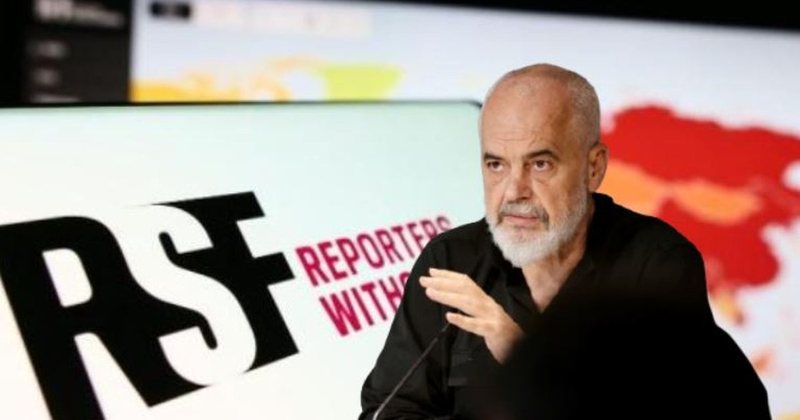
This Tuesday, Albania and the European Union will hold the 8th Intergovernmental Conference on the accession negotiation process in Brussels.
At this important meeting, Prime Minister Edi Rama also has a message for Reporters Without Borders.
Rama's full post:
I am heading to Brussels where today Albania will take another important step on its path towards membership in the European Union. An essential part of this journey is, of course, both the progress achieved and the work that still needs to be done regarding the media environment.
And we will do this in full cooperation with the EU. But since I haven’t heard from you since I shared the rather revealing report generated through an artificial intelligence model developed by an Albanian startup, I thought it would be useful to send you the findings of a follow-up analysis from the same source, this time with an extended monitoring period of 120 days, covering 106,962 articles in 47 monitored media outlets.
I hope you will be pleased to learn that, regarding the well-known thesis of a “captured media” environment, the larger the sample becomes, the weaker this thesis seems to be. Just imagine: empirical indicators place Albania 33 percentage points below the threshold associated with structurally captured media systems. Incredible, right? But true. The share of the opposition Zëri reaches 68.2%, while the visibility of the government is at 31.8%. Most striking is that even within media outlets that are usually labeled as pro-government, the visibility of the opposition remains higher than the visibility of the government itself.
Moreover, criticism of the government outnumbers positive coverage by nearly five to one. This is hardly the profile of a country where criticism is silenced, opposition voices are marginalized, or media pluralism is merely decorative.
Again, in a truly “captured” media environment, none of this would exist. Not a landscape where opposition visibility dominates even in supposedly pro-government media. Not criticism that outnumbers positive government coverage by nearly five times. Not opposition voices that consistently dominate all categories of critical, balanced, and pro-government media alike. And again, these are not perceptions. They are quantifiable facts, drawn from a dataset of more than 106,000 published articles.
The larger the sample size, the harder it becomes to reconcile these findings with the notion of a media landscape captured by government influence. I trust you will enjoy the attached report. I will be happy to return with further findings in the future, in the spirit of mutual respect, constructive collaboration, and our shared commitment to that often elusive but always worthwhile destination: Truth.
Happening now...




ideas

Enver-Sali!
Nga Indrit Vokshi
Idolaters and idolatry have nothing to do with democracy!
Nga Ardi Stefa

top

Alfa recipes






services
- POLICE129
- STREET POLICE126
- AMBULANCE112
- FIREFIGHTER128