


FLASH NEWS
How Lulzim Basha "deceived" the Democrats about Sali Berisha!

2026-05-24 10:45:16 / EDITORIAL
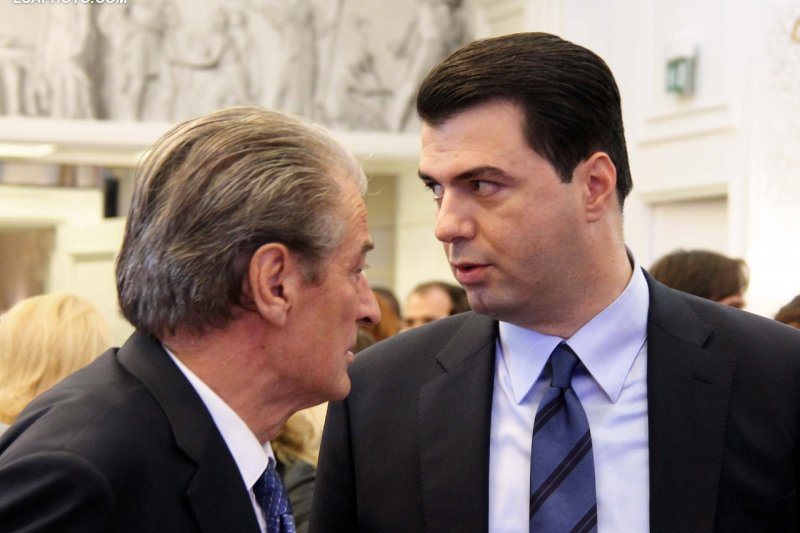
In Albanian politics, memory is often shorter than interest. What was sold as a “cause” yesterday, today turns out to be a well-orchestrated illusion. Democrats were asked not to believe what they saw — the vision and the future — but to believe in the past and nostalgia. As Voltaire said: “Those who can make you believe absurdities can also make you commit injustices.” It was precisely on this absurdity that the narrative was built that paved the way for the return of Sali Berisha, while Lulzim Basha became the figure who had to be overthrown to make this return acceptable.
It was not a mistake. It was not even a political misunderstanding. It was pure manipulation that cost the Democratic Party not only disunity, but also the loss of self-confidence. What today seems like a crisis is actually the product of a strategy built on emotion, myth, and the distortion of truth.
When Lulzim Basha made the decision to expel Sali Berisha from the DP and openly articulated the Berisha-Rama-Meta political triangle, he established a clear dividing line: Between a policy based on strategic alliances and a policy based on personal interests.
At that moment, the “power of rumors” built a myth: Berisha was presented as a victim of the US and the “Soros clans”, but at the same time as the only person who could overthrow Edi Rama. A paradox that only a party in crisis could digest. The Democrats were served an emotional and primitive narrative: “Fathers do not break their trust”. And thus, a political force was reduced to an almost family relationship, abandoning the rational standard, because when emotion rules over reason, the truth becomes the first victim.
The paradox deepened even more when Edi Rama himself began to call Berisha a “statesman.” But the facts show the opposite: a statesman does not burn his house to save himself. Whereas what happened to the Democratic Party was precisely this controlled burning and destruction for personal interests.
Meanwhile, the narrative that Berisha was the only one who could bring victory drowned out any debate on principles. Instead of a pro-Western opposition, an anti-American spirit began to be cultivated, a dangerous deviation for a party that was born to be linked to the US.
Then came the most cynical phase: Bargaining. MPs who moved not for conviction, but for personal interests; strategies that were built not for political victory, but for individual survival. MPs who saw their personal pockets and not how the Democratic Party could become a winner. Therefore, today the balance is brutal: a more divided DP and about 300 thousand fewer votes compared to 2021.
Yesterday, Sali Berisha was re-elected as leader of the Democratic Party through a referendum where he was the only candidate, a process without real competition and without convincing political legitimacy. Berisha pledged to do everything for the Democrats, but he has still not answered the essential questions: why did he lose the battle for the “non grata” in France? Why does the British ambassador declare that the “non grata” declaration is legal? Why didn’t Donald Trump remove the “non grata”? Why didn’t he manage to defeat Edi Rama? And above all, why didn’t he manage to unite the Democratic Party?
The irony is merciless. Those who yesterday were screaming about the “injustice” towards Berisha, today are talking about failure. Those who yesterday were attacking Basha for his stance towards Berisha, today are repeating his exact theses. But this is not just hypocrisy; it is a collective failure to understand politics beyond emotions.
In this reality, Lulzim Basha, with all his costs and mistakes, remains the politician who articulated a principled line: that a Democratic Party cannot be against the US, cannot be against SPAK, and cannot be turned into a bunker for one man's personal troubles.
He did not choose the easy path of populism or bargaining. He chose to face a difficult truth and today, even though outside Parliament, time is giving him a right that does not need rhetoric: the Democratic Party cannot come to power under the leadership of Sali Berisha.
As Arthur Schopenhauer quoted, the truth goes through three stages: first it is ridiculed, then it is opposed, and finally it is accepted. The truth that is emerging today is this: Berisha's return was not a project to defeat Rama, but a strategy to use the Democratic Party as a personal shield.
Happening now...














ideas


top



Alfa recipes








services
- POLICE129
- STREET POLICE126
- AMBULANCE112
- FIREFIGHTER128