


FLASH NEWS
Georgia Keeffe, a great artist who entered painting through the abstraction of the natural world

2025-11-16 17:31:53 / JETË
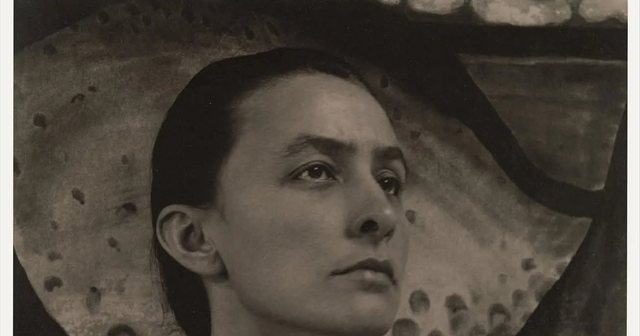
Georgia O'Keeffe played a key role in the development of American modernism and its relationship with the European avant-garde movements of the early 20th century. Producing a significant body of work over seven decades, she sought to capture the emotion and power of objects through the abstraction of the natural world. Alfred Stieglitz identified her as the first American female modernist, whose paintings of flowers, barren landscapes, and still, close-up natures have become part of the mythology and iconography of the American artistic landscape.
O'Keeffe incorporated the techniques of other artists and was particularly influenced by Paul Strand's use of cut-outs in his photographs. She was one of the first artists to adapt the method to painting, making close-ups of uniquely American objects that were highly detailed yet abstract.
O'Keeffe did not follow any particular artistic movement, but like Arthur Dove, she experimented with abstract motifs from nature. She worked in series, synthesizing abstraction and realism to produce works that emphasized the basic forms of nature. While some of these works are highly detailed, in others, she stripped away what she considered necessary to focus on form and color.
Through intense observation of nature, experimentation with scale, and nuanced use of line and color, O'Keeffe's art remained grounded in representation even as it pushed its boundaries to the extreme. In particular, from the 1940s to the 1960s, O'Keeffe's art was outside the mainstream, as she was one of the few artists to adhere to representation, at a time when others were exploring non-representation or had abandoned painting altogether.
Widely recognized for her contributions to modern art, O'Keeffe grew up in a family that valued education. She attended the Art Institute of Chicago and the Art Students League in New York and was deeply influenced by the principles of Arthur Wesley Dow, who emphasized the importance of composition—which included line, color, and shadow—in creating art.
O'Keeffe's work spans several decades and is iconic for her large-scale, close-up paintings of flowers, which were often interpreted as reflections of the female form, although O'Keeffe herself resisted such readings of her work. Her paintings of New York City buildings and landscapes, as well as her later works inspired by the New Mexico landscape, also gained her significant attention and acclaim.
By the 1920s, O'Keeffe was recognized as one of America's most important and successful artists, known for her unique style and pioneering abstraction. Her marriage to photographer and art dealer Alfred Stieglitz was an important partnership. Stieglitz was a prominent advocate of her work and frequently exhibited her paintings at his gallery, called '291'.
In 1946, after Stieglitz's death, O'Keeffe moved to New Mexico, where she found inspiration in the desert environment and Native American culture. Her paintings from this period include depictions of vast landscapes, bleached animal skulls, and flowers of the American Southwest. From this period, her Ram's Head, White Hollyhock-Hills (1935) is considered one of her most important works.
Georgia O'Keeffe continued to work until the late 1970s, when failing eyesight forced her to retire. She remained, however, a prominent figure in the art world and a symbol of American perseverance and independence. In 1985, President Ronald Reagan awarded her the National Medal of Arts, and her legacy is preserved by the Georgia O'Keeffe Museum in Santa Fe, New Mexico.
Georgia O'Keeffe was one of the most famous American painters of the 20th century, known for her powerful and often symbolic art depicting the nature and landscapes of the American Southwest. She was born on November 15, 1887, in Sun Prairie, Wisconsin, and spent much of her life in major cities such as Chicago and New York City, before settling in New Mexico, a place that inspired many of her most famous works.
O'Keeffe became known for her large, abstract paintings of flowers, which many critics saw as symbolic representations of femininity. However, O'Keeffe denied that her work had such sexual connotations and emphasized that her work was primarily devoted to form and color.
Georgia O'Keeffe left behind a rich legacy and is considered an icon of American modernism. She died on March 6, 1986, leaving a profound mark on contemporary art and the perception of the American landscape.
-

Zelensky calls on allies: We need more air defense systems, Ukraine needs…
November 16, 17:26 -

-

Happening now...















Germany, the "curse" of Rama and Berisha
Nga Bato Kosova
ideas

The opposition must and will be bigger than an individual.
Nga Taulanda Jupi

Violent protests as group therapy
Nga Roland Lami

Those who mocked and attacked Basha
Nga Ermal Peçi
top


Alfa recipes



TRENDING 




services
- POLICE129
- STREET POLICE126
- AMBULANCE112
- FIREFIGHTER128