


FLASH NEWS
How the discovery of the first Neanderthal overturned and rewrote human history

2025-12-07 08:57:04 / MISTERE&KURIOZITETE
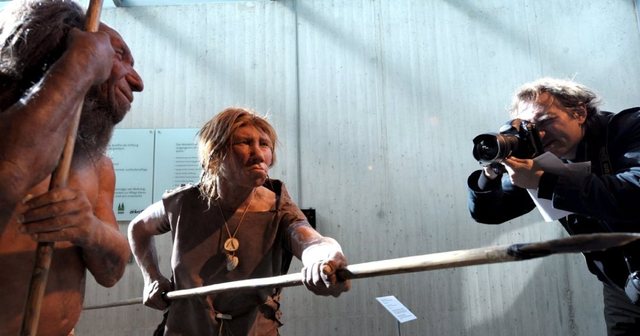
A new BBC video titled "Neanderthal 1: The incredible discovery that rewrote history" brings back to the forefront the historic discovery of 1856 in Germany, when the first Neanderthal remains were found and officially recognized as the remains of a distinct human species.
It was the moment when human evolution stopped looking like a straight, one-dimensional path and began to reveal itself as a much more complex network of related species.
The story begins in Neanderthal Gorge, where quarry workers discovered 16 bones inside the Feldhofer Cave. At first, no one could understand their significance, but researchers would soon conclude that they did not belong to modern humans. “Neanderthal 1” became the first anthropological find to show that Homo sapiens was never alone on the European continent.
This discovery challenged the concept of linear evolution for the first time. As the BBC notes, the presence of Neanderthals proves that our ancestors coexisted and genetically mixed with other human species. Today we know that millions of people still carry parts of the Neanderthal genome, while almost half of their genome survives scattered in modern populations outside Africa.
The documentary also highlights that Neanderthals were far more advanced than the stereotype of “savage” humans that dominated their public image for years. Archaeological findings show that they had social organization, survived in harsh environments, and used decorative elements such as bird feathers, indicators that point to symbolic behavior and cultural development. Modern genetic analyses, studying genes such as NOVA1 and TKTL1, show that Neanderthals had different but equally specialized evolutionary adaptations, especially in terms of brain development.
Another element highlighted by the BBC is the rediscovery of the original site after more than a century. Identifying the site where Neanderthal 1 was found has allowed researchers to better reconstruct the environment, conditions and possible activities of people at the time, providing valuable new information.
The historical significance of the discovery, as the mini-documentary highlights, lies not only in the identification of a new species, but also in the way it fundamentally changed our understanding of the past. Neanderthal 1 revealed that human history is not an “us and the others” narrative, but a shared journey, full of intersections, affinities, and evolutionary interaction.
The BBC video concludes that this first discovery didn't just uncover an unknown species. It overturned the very basic principle that "humans are unique."
Happening now...
















The revolution is over, Edi Rama continues calmly
Nga Bato Kosova
ideas



top






TRENDING 




services
- POLICE129
- STREET POLICE126
- AMBULANCE112
- FIREFIGHTER128