


FLASH NEWS
The Albanian flag in the biblical picture/ Renaissance Europe saw Skanderbeg as Mordecai

2026-01-19 13:02:31 / JETË
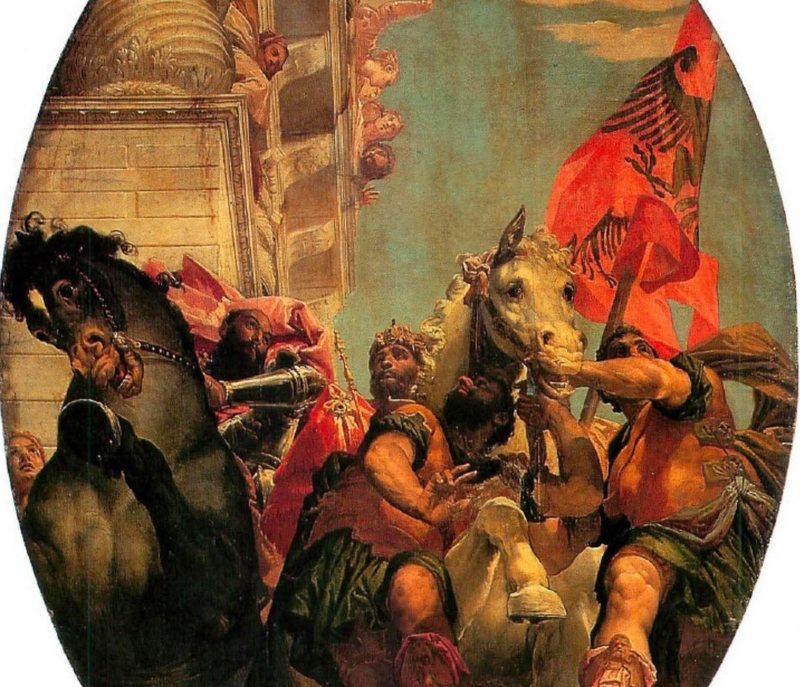
In 1556, in Venice, Paolo Veronese painted the Trionfo di Mardocheo, a biblical scene located in the church of San Sebastiano. At first glance, it tells the story of the triumph of Mordecai – the Jewish figure who saved his people from extermination in the Babylonian Empire. But Renaissance art rarely speaks only about what appears. It speaks in codes. And this code is deeply political.
In the center of the painting appears a triumphant figure on horseback, holding a red flag with a black double-headed eagle. This symbol has no biblical connection. It is the Albanian flag. And this completely changes the reading of the work. According to modern readings, the figure of Mordecai serves as a symbolic mask for Gjergj Kastrioti Skanderbeg – the Albanian hero whom 15th-century Europe saw as the defender of Christianity in the face of Ottoman expansion.
This is no coincidence, nor is it a late nationalist projection. In the 16th century, the use of biblical figures to represent real historical figures was common practice. Mordecai embodied the idea of the savior of a threatened people. Skanderbeg, in the European mindset, fulfilled the same role: a border figure, a keeper of order and Western civilization.
The presence of the Albanian flag is decisive evidence. If the painting were purely biblical, this symbol would have no reason to be there. But Venice knew the flag, its image and its meaning. The public of the time read the message without the need for explanation: this is not just a story from the Bible, but a very concrete political parallelism.
This work debunks some myths prevalent today. Skanderbeg was not a provincial figure without European echoes; he was part of the continent's political imagination. The Albanian flag is not a recent invention; it was already an internationally legible symbol in the 16th century. And Albania was not outside European history, but located precisely on one of its most sensitive borders.
The irony is bitter: while Renaissance Europe elevated Skanderbeg to a mythical level, today in Albanian debate his figure is often relativized, trivialized or treated as folklore. Trionfo di Mardocheo reminds us that art, sometimes, preserves historical memory more clearly than textbooks.
On the walls of a Venetian church, the Albanian flag does not appear as decoration. It appears as a statement: a symbol of a defense that Europe knew had changed its fate. And this is a message that deserves to be reread even today, without complexes and without forgetting. / Prepared by Sokol Neçaj
Happening now...
















The revolution is over, Edi Rama continues calmly
Nga Bato Kosova
ideas



top







TRENDING 




services
- POLICE129
- STREET POLICE126
- AMBULANCE112
- FIREFIGHTER128