


FLASH NEWS
The beauty of Durrës returns to the coastal city after 45 years

2026-01-03 20:58:12 / JETË
The National Archaeological Museum of Durrës will keep its doors closed for several more months. Specialists have begun work on organizing the objects on the first floor of the building, whose exhibition is dedicated to the period of antiquity, while they have not yet begun to treat the objects from the medieval period, which will be installed on the second floor.
The courtyard, which will have the appearance of an archaeological park, is almost completed, while a walkway of several hundred meters is being designed that connects the Museum with the discovery site of the Roman dwelling, on the foundations of the former "Gjergj Kastrioti" high school.
This pedestrian street will serve for tourist visits to both important sites of the ancient city.
Restoration works at the Archaeological Museum of Durrës have begun in 2022. Despite the delays caused during the implementation of the project funded by the EU4Culture program, which will delay the commissioning of the Archaeological Museum, some good news is directly related to one of the most important discoveries of the beginning of the last century.
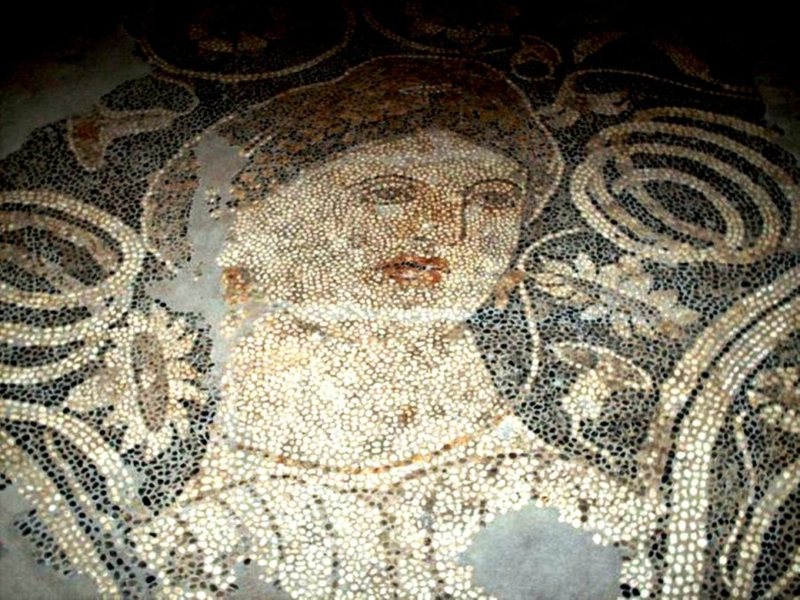
The mosaic known as the "Beauty of Durrës" will soon be placed at the entrance to the National Archaeological Museum of the 3,000-year-old city.
An order from the Minister of Culture, Blendi Gonxhja, has put the institutions in motion and now the mosaic that adorned the entrance to the National History Museum in Tirana has been prepared in several pieces to be transported to the ancient city.
The same team of specialists that transferred and installed the well-known Durrës mosaic at the entrance to the National History Museum in 1981 will bring it to Durrës, the city where it was discovered in 1916 by Austrian military archaeologist Camillo Praschniker.
The “Beauty of Durrës” is the most remarkable mosaic discovered in our country. It was found by chance during the Austrian army’s work in World War I to open a fortification trench in the center of Durrës.
The Austrian officer Camillo Praschniker, who was also a prominent archaeologist, took care to preserve the mosaic layer. He was the first to publish a photograph of the mosaic in his archaeological book about Albania, calling it a masterpiece of figurative art.
The mosaic was then covered up again and lost for 33 years.
The persistence of the distinguished archaeologist Vangjel Toçi brought to light in 1959 one of the most important monuments of our ancient cultural heritage.
Senior scientific collaborator, Vangjel Toçi, carefully followed the data written by two Austrian archaeologists, Schober and Praschniker, at the beginning of the 20th century, regarding the presence of mosaics in one of the central neighborhoods of Durrës.
Thanks to his persistence and professional skills, the Durrës archaeologist Vangjel Toçi rediscovered the 2,300-year-old mosaic in 1959. Contemporaries recall the archaeologist's long conversations with the city's elders, as well as the information he gleaned from a book published in 1920 by archaeologists Schober and Praschniker.
The mosaic was located at a depth of 3.80 meters in the foundations of a two-story house, just 150 meters behind the city's "Aleksandër Moisiu" theater building.
The mosaic was transferred to Tirana in 1981 to be installed at the entrance of the National History Museum, while in a few weeks it will be part of the National Archaeological Museum of Durrës, the city where it was discovered almost 110 years ago./ Reporter/
Happening now...













The revolution is over, Edi Rama continues calmly
Nga Bato Kosova
ideas



top





TRENDING 




services
- POLICE129
- STREET POLICE126
- AMBULANCE112
- FIREFIGHTER128