


FLASH NEWS
BIRN: Behind the collapse of Albania's roads lies 'clientelism and corruption'

2026-02-08 09:33:00 / POLITIKË
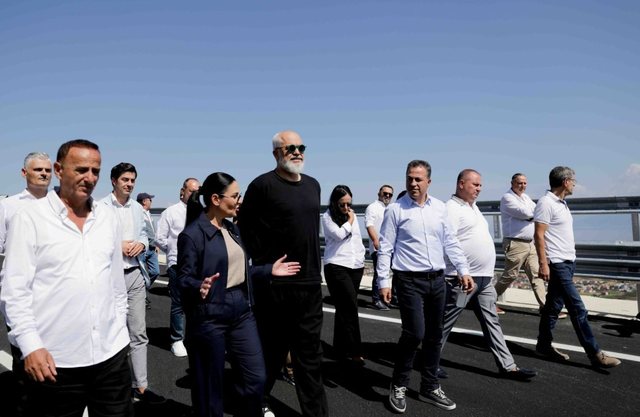
To the sounds of drums and the rhythm of folk dances, Prime Minister Edi Rama and Deputy Prime Minister Belinda Balluku walked a few meters on foot on the newly laid asphalt on the Qukës-Qafë Plloçë road segment on September 5, to inaugurate the completion of the works.
Investment in the 43-kilometer segment, also labeled as the 'golden road,' began 15 years ago and is believed to have cost Albanian taxpayers nearly $260 million to connect the village of Qukës in Librazhd with Qafë e Plloçës in Pogradec.
But the multi-year, multi-million dollar investment was blocked just two months after its inauguration, after a mass of stones fell from the side slopes at the end of November and a few weeks later suffered a complete collapse of the curb and sidewalk on one of its axes near the village of Geshtenjas.
The Road Authority 'blamed' heavy rain for the damage, but this was not an isolated incident.
The panoramic axis of the Shëngjin-Velipoja road, the lower ring road of the city of Burrel or the Murrizit tunnel on Arbri road also showed defects and problems during the winter season, despite the costs and sensational inaugurations. A video made by passers-by in early January in the Llogara Tunnel, where water was seen flowing from the ceiling of the tunnel, was also circulated to the public with alarm.
The Llogara Tunnel, along with other infrastructure projects, have been seriously questioned, after an investigation by the Special Prosecution Office revealed the manipulation of the competition and the predetermination of the winning companies through the intervention of Minister Belinda Balluku, also the government's number 2.
But a request by SPAK to lift Balluk's immunity has been held hostage in the Assembly by the socialist majority since December 16 of last year.
For infrastructure and economic experts, the incidents of recent months with roads should not be seen as isolated, but as part of institutional irresponsibility and corrupt and clientelistic connections in the distribution of public funds.
"The construction of these roads is not done to steal, but to rob," says engineer Xhevahir Ngjeqari, who links their safety problems to the way they were designed, without proper technical studies and with the aim of "economic benefits."
According to him, every infrastructure work, as a rule, must undergo consultation with several technical councils and proper geological studies or studies in the public interest must be carried out, procedures that, according to him, have been bypassed or have been carried out fictitiously.
"Here they are out of control, they are projects done in a hurry, without technical studies," adds Ngjeqari.
Even according to Zef Preçi, director of the Center for Economic Studies, the visible consequences are related to the clientelism of the entire process of conception, design, construction, supervision and up to the handover of these works.
"Generally, the design of public infrastructure works is carried out with poor quality, in many cases without violating the physical terrain at all, but only on the basis of maps obtained from Google Maps, geological studies are missing, and the sector's development master plans are ignored...," Preçi told BIRN.
"Even in cases where big-name foreign companies are involved in the design, the actual work is done by local designers, often underpaid and simply to formally justify the usefulness of a particular public work," he added.
Clientelism, according to Preçi, continues throughout the chain, as companies or engineers tasked with supervising the execution of works are often selected under conditions of conflict of interest. Thus, reports on the volume and quality of works reported in the companies' statements are inflated, fictitious and not in accordance with the respective projects.
Preçi suggests that infrastructure works are generally carried out with low quality and in serious violation of the designed technical parameters, because according to him, "builders aim to maximize their profits and in many cases the funds are used to fuel government corruption."
Experts consider some of the costly projects to be of no public or economic interest to the country, but which come to life due to the financial interests hidden behind them.
"The Llogara Tunnel is an anti-national act," says Ngjeqari, explaining that from a technical point of view, the composition of the limestone mountain and the flow of water were not taken into account. Another example of the lack of economic benefit, according to him, is the Qukës-Qafë Plloçë road, for which he says studies were missing in the project phase.
Zef Preçi speaks of a clientelist model of awarding infrastructure tenders spread across the country, where winning businesses are registered on behalf of politically exposed persons.
"Studies show an exponential increase in the tenders that these companies win, thus violating not only equality before the law, but also significantly worsening the business climate in the country," he says.
Preçi believes that at least half of the funds dedicated to infrastructure projects "have not been truly invested in the country's economy, but have served to strengthen certain government client companies."
“…have fueled the illicit enrichment of decision-making and law-making segments of the country’s political elite,” he concluded./BIRN
Happening now...








ideas

Renaissance is Disaster Capitalism
Nga Klodian Tomorri
Pse tifozeria e Kosovës ishte aq e vdekur dhe mungonin simbolet kuqezi?
Nga Kreshnik Spahiu

top



Alfa recipes



TRENDING 




services
- POLICE129
- STREET POLICE126
- AMBULANCE112
- FIREFIGHTER128