


FLASH NEWS
How the civic voice was silenced

2025-11-28 22:41:34 / IDE
This October, I started a collaboration with BIRN to produce several reports on various topics, mainly social and environmental. I willingly took on this project, because it was field work that required intensive communication with different communities. The topics were precisely related to the confrontation of communities with institutions, for violated rights. I started from Durrës, with the residents affected by the TID project, who were in protest those days and the report seemed easy to produce. I interviewed several residents of Durrës, who told how their property was being looted, houses where they had lived for generations… they were hurt that no one was supporting them. I asked them if they had participated in any protests where other communities were similarly threatened… with their heads down they answered: actually no and wrong… because that’s how it is when trouble comes to our door…”
For the next reportage I headed towards the hunger strike of the oil workers of Marinza and at the other end in Spaç, where the miners were also on strike. Communication was easy there too, because everyone was committed to talking about their rights. They told me about the difficult working conditions, the low wages, the discrimination in relation to foreign workers, they told me how their tests show poisons in their blood and each of them suffers from diseases that come as a result of their profession. Oil workers and miners, they told me how the companies do not treat them from a health perspective or in the worst case, falsify their tests. “We are treated like slaves on our properties and state institutions not only do not protect us but have become partners with the exploiting companies” – they said in revolt. The strikes ended without any success, while the Albanian institutions did not appear for a moment. Most likely they will not protest again, because after a month on strike they did not get any results, the protest lost its meaning.
Work began to become more difficult for other topics. In the village of Marqinet, a few kilometers from the capital, 70 families were left homeless by the earthquake of November 26. For six years, two families have been living in containers in a neighborhood of this village. They are staying there in the cold and heat, waiting for the shelter that was promised to them after the earthquake. Promises that they repeated in every campaign, but the residents no longer complain. And their silence has an explanation, because when the prime minister went there in one of the last campaigns to ask for votes, one of the residents had the courage to ask why their houses were never built and when their problem would be solved. Kastriot is called. The prime minister's quick response was to throw him out of the activity hall with stigmatizing jokes, while the rest The rest of the residents who had previously agreed to talk about the same plight lowered their eyes. Now, Kastrioti is no longer speaking either.
When I went to meet the families living in the container this November, they came out the door angry. “Why are you bothering us? We don’t talk anymore.” “What do you have to lose?” I asked. “I have nothing… well, I’m here.” “Okay - you mean covering the leaking roof with tin?” – I continued asking. “Yes, we’re covering it with tin… we’re very good… I have no complaints…” – they replied.
In Albania, people no longer expect state institutions to fulfill their role, on the contrary, they are afraid of them taking away even the little they have left: an iron box, where they can sleep at night. Perhaps thousands more in the Kombinat neighborhood, Durrës, Krujë, Thumanë, Laç, etc. live with rent that is no longer paid as promised, even though €1.15 billion was collected in their name.
Another topic is related to “schools without children and children without schools”. We went to dozens of village schools, where we found buildings engulfed in silence, like museums without a single visitor, with desks turned upside down in classrooms or abandoned, as if the last class had just ended. Somewhere you can only hear the creak of the school door opening and closing in the wind, somewhere else a school where 6 children study and when they go out for the long break they play in the yard with the chickens. Somewhere else the school has been turned into a commercial hotel-service unit where women will do winter zaires. In many other villages there is no longer any voice, no hope, no reason to keep the school open. These are the places where you understand that abandonment comes slowly, silently, until there is no one left to complain.
Another topic: Albania's rivers are a natural treasure, with wild flows and rare ecosystems, but today they are under pressure from mining, hydrocarbon activities, hydrotechnical interventions and poor waste management, making their protection a major environmental challenge.
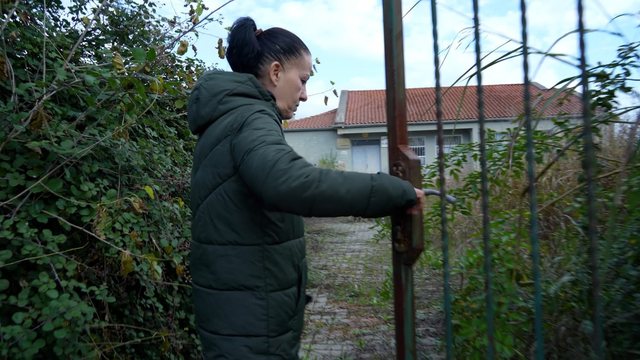
In Fushë-Arrëz, the Fan River comes clear from the mountains and turns red as it passes under the copper enrichment plant on the slope next to the city. Pollution from the mine waste reaches the fields of nearby villages and runs through the entire valley until it joins the Mati. The polluted water flows towards the roots of plants and trees that people and animals feed on. Residents do not dare to speak out, because their sons and husbands work in the mine. A colleague, a local journalist, told me that a few months earlier they had complained to the media that the mine waste had entered the yards; and the next day they were threatened with firing everyone. Some took them away. Then they brought them back, only after the residents promised never to speak again. When we go to meet them, they refuse to open the gates and beg us to leave: “Go away. Please go away. Don't bring the camera near.” There, the drama needs no dialogue, fear and silence speak louder than any interview.
Meanwhile, the institutions say that the water is clean. Statistics say that there are no convictions for environmental crimes. Some environmental crime cases are pursued by the police in minimal numbers, much less end up in the prosecutor's office and no court decision for punishment of environmental crime. The reasoning is as ridiculous as their statistics: there is no evidence, while the red water of the river continues to flow. There are no perpetrators, say the prosecutor's office and the court...
After traveling to dozens of villages in all four corners of Albania, I see the same ritual: fear, misery, silence. A country where institutions are completely indifferent, where foreign companies take everything and leave the land crippled. A country where citizens no longer speak, not because they have nothing to say, but because every word has a cost for them: loss of their job, shelter, bread, life.
This experience of traveling around Albania has saddened me, but it has clarified for me why and how the voice of protest was silenced in this country, where there is no one to protect the citizen.
Happening now...











Karmën nuk e ndalon dot Sali Berisha!
Nga Bato Kosova
ideas

"Topple" Edi Rama by lying to yourself...
Nga Patrik Sadikaj


Only accepting Berisha's truths will save the DP from final extinction!
Nga Neritan Vladi
top





TRENDING 




services
- POLICE129
- STREET POLICE126
- AMBULANCE112
- FIREFIGHTER128