


FLASH NEWS
Nano, the man who did not fall victim to his own power!

2025-10-31 15:10:50 / IDE
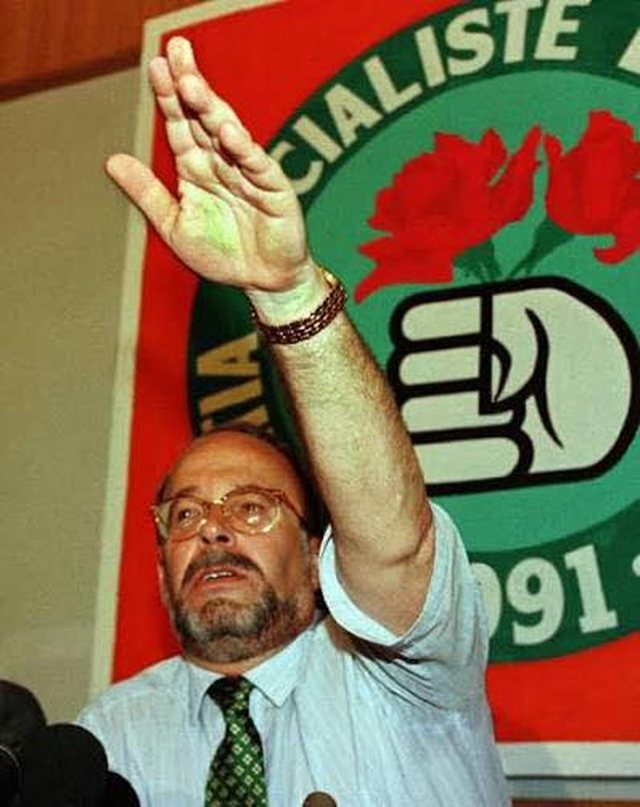
If there is a politician whom time immediately placed as a “sandwich” between “the old that is collapsing and the new that is being born”, this is Fatos Nano.
He started his political career on the other side of the barricade. At the moment when the dictatorship was crumbling in the face of pressure from time and students, unlike many intellectuals, he aligned himself with the Party of Labor. In December 1990, he appeared as the “liberal man”, the facade that the regime needed to use to show that “we are changing too”. From Secretary General of the Council of Ministers, he quickly reached the top of the pyramid.
In February 1991, he was appointed Prime Minister in the transitional government, to immediately face the miners' strike, which brought down his government.
Only four months later, in June 1991, he was elected chairman of the successor party of the Albanian People's Party. The task was almost impossible: transforming the communists into a socialist force.
This was perhaps his greatest challenge: to make the 120,000 members of the Albanian People's Party change their mentality, status, and style, and to accept that another era had come; that power did not belong only to the communists and that they were not facing the enemies, the reactionaries, the Ballists and the Zogists, but the Albanians.
On March 22, 1992, the Socialist Party (SP) lost heavily in the parliamentary elections, a sign that Albanians were expecting radical change. Just three months later, in the local elections, the SP recovered quickly. This recovery shows the ability of Nano and his team to reflect, to reorganize and to survive politically.
In the meantime, his arrest and imprisonment came, in a process that left more shadows than light. He was accused and convicted of abuse of office and falsification of documents, in connection with Italian aid. Prison cemented the position of party chairman and turned him into a political "martyr". (He is one of those who initially did prison, then oppression - a keen observer of political life said with a sneer)
When the country fell into total chaos in 1997 (the collapse of pyramid schemes), Nano returned to the leadership of the Socialist Party with the grand promise: "The lost money will be returned." He did not take revenge for what he had suffered; on the contrary, he tried to rebuild the ruined economy and calm down as much as he could a country armed to the teeth.
Only 14 months later, after the murder of the Democratic MP Azem Hajdari, he resigned, leaving the leadership to two young people from the Eurosocialist Youth Forum (Majko-Meta).
In 2002, he returned for the third time as prime minister. In this mandate, he tried to balance the powers, work for the independence of institutions and ensure that the rotation was done at the ballot box and not on the street or by force.
"The organization of free and fair elections is more important than the result" - this saying attributed to Nano did not just express an ideal far from the reality of the time, as it became a reality very quickly.
This period also marked the great political peace, after a long conflict with his rival Berisha. (election of the President by consensus, several appointments to the High/Constitutional Court, electoral reform)
During his “government” (2002-2005), power was shared not only with allies, but also within the Socialist Party itself, allowing the emergence of strong political figures both within the cabinet and within the parliamentary group.
In retrospect, what was called and accused of corruption during his time often seems like a puppet show when compared to the affairs of the last decade, a painful contrast that places Nano’s period in a different light, where and where paler, compared to today’s affairs and greed for power and wealth.
In 2005, the SP lost the parliamentary elections, and Nano resigned from the party leadership. He used the last bullets of political capital in Parliament to have Bamir Topi elected President in 2007.
In 2012, he himself aimed for the post of head of state, but he immediately realized how lonely he had become. His desire and insistence on returning clashed with a brutal truth: the many friends in politics are temporary and belong only to power, not to the person.
He spent his last years in silence, like a man who had fought the great battles early and intensely, mainly imposed by time and fate.
Nano was a man with passions and vices (drinking, gambling, negligence), which often made him the object of criticism and gossip.
Ironically, his "liberal" nature and the vices themselves made him more human, more accessible, creating a contrast that highlighted his virtues even more. They called him a liberal, but tolerance was his vice.
The reform and democratization of the Socialist Party, the separation of powers (compared to today's concentration); the organization of free elections (compare today after 20 years); the handover of power and the inculcation of the idea that the state does not belong to a single party, are the contributions of Fatos Nano to the Albanian transition.
In political retrospect, Fatos Nano stands out as the "sandwich" that provided a space for "liberalism" between two powerful and often authoritarian models of governance: the centralized power of Sali Berisha in the 1990s and the long authoritarian dominance of Edi Rama in the last decade.
He was called to the scene in December 1990 and lived 15 intense political years. He departed peacefully both from political leadership and from this life, leaving behind a debatable but undeniable legacy!
Happening now...







ideas

The Statute Review and Berisha's Sinking Boat
Nga Alesia Balliu

Will the new justice system unite the SP and the DP?
Nga Arbër Hitaj

Sovereignty as a fig leaf
Nga Namir Lapardhaja
top






TRENDING 



services
- POLICE129
- STREET POLICE126
- AMBULANCE112
- FIREFIGHTER128