


FLASH NEWS
70-million-year-old fossil of North America's largest dinosaur discovered in Texas

2025-04-22 07:58:34 / MISTERE&KURIOZITETE
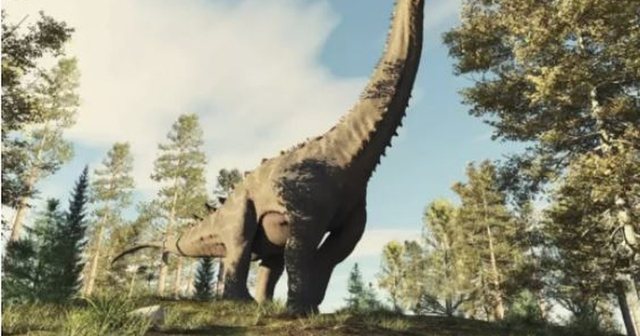
A team of paleontologists from Sul Ross State University has discovered a giant fossilized dinosaur bone from Big Bend National Park in west Texas.
The discovered bone is part of an Alamosaurus, a long-necked dinosaur that likely roamed North America in the late Cretaceous period from about 70-66 million years ago.
“Alamosaurus is the largest known land-dwelling animal to have lived in North America,” the press release noted .
Interestingly, it is the only Late Cretaceous sauropod found in North America.
In March, university paleontology students undertook a research trip to the park that led them to this important find.
The main goal was to research the Cretaceous and Eocene rock formations of the region.
What they discovered was an extraordinary find – a large vertebra belonging to Alamosaurus.
Alamosaurus was a genus of titanosaurian sauropod dinosaur that lived during the Late Cretaceous period.
The genus includes only one known species, Alamosaurus sanjuanensis. The name Alamosaurus comes from the Ojo Alamo Formation, New Mexico, where the first fossils were discovered in 1922.
Like other sauropods, Alamosaurus also had an unusually long neck and a whip-like tail.
According to the park's website, Alamosaurus had a wider distribution, with fossils also identified in Utah, Wyoming, and the Big Bend region of Texas. Fully grown adults of this species were likely around 70 meters in length.
However, fossils are often "fragmented and poorly preserved."
This latest discovery by the Sul Ross team is believed to be part of one of the most complete skeletons discovered from this area, first documented by University of Texas researchers in the 1970s.
After being successfully recovered from the field, the Alamosaurus vertebra is now located inside the paleontology laboratory at SRSU.
The press release states that the new bead is being studied alongside beads previously found from the same quarry.
Big Bend – a treasure trove of fossils
Big Bend National Park has long been known as a treasure trove of dinosaur fossils.
Among these extraordinary finds are the fossilized remains of a giant pterosaur, an ancient flying creature that coexisted with dinosaurs. The fossil remains suggested it had a wingspan of approximately 36 feet.
Adding to the park's unique prehistoric record is the massive skull of Bravoceratops polyphemus, a giant horned dinosaur.
It is said that Bravoceratops is currently known only from fossils discovered within Big Bend National Park, making it an important element in understanding the diversity of horned dinosaurs during this period.
The Big Bend region has recently yielded important ancient discoveries.
In March, a hunter discovered a mammoth herd at O2 Ranch, further demonstrating the area's importance as a rich archaeological site. In addition, archaeologists recently discovered what may be the oldest intact complete weapon system in North America, found hidden within a remote cave system south of Marfa, which could be linked to early human populations in the area.
Happening now...
















ideas

Silence as a policy and fear as a system
Nga Sokol Neçaj

Is Spiropali a "Magyar", facing the autocrat Rama?!
Nga Neli Demi

American Libra!
Nga Arian Galdini
top



Alfa recipes








services
- POLICE129
- STREET POLICE126
- AMBULANCE112
- FIREFIGHTER128