


FLASH NEWS
The Guardian "speaks" Albanian, special article on Kosovo: The Tale of the World Cup

2026-03-27 21:11:44 / SPORT
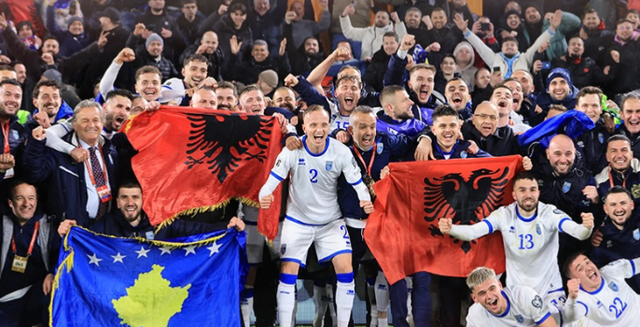
Kosovo defeated Slovakia 3-4 and is now in the World Cup Play Off final, where they will face Turkey. The prestigious "The Guardian" has written a special article about the Dardanians.
They are a World Cup sensation, a footballing nation barely a decade old with fewer inhabitants than the state of South Australia. A Balkan “West Virginia”, but with a smaller area and a troubled past, so writes the prestigious British newspaper about Kosovo’s victory over Slovakia last night.
"Little" Kosovo is just one match away from its first World Cup appearance, and a place in Group D alongside Australia, Paraguay and co-hosts, the United States.
All that separates them is a single play-off match, all or nothing, against Turkey at home in Pristina on Tuesday. It's a magnificent conclusion to a qualifying campaign that has become a rallying cry for optimism and national pride.
Kosovo coach Franco Foda said Tuesday's match would attract 100,000 people - close to half the population of the capital, Pristina - if the Fadil Vokrri Stadium were big enough to accommodate them all. Unfortunately, its capacity is only 14,000, although 25,000 turned up for a performance by rapper 50 Cent in 2007, which was a significant moment of post-war healing.
This is a place where conflict is not easily forgotten. Not far from the stadium, a police station was bombed by NATO during the 1998-99 war. In the north of the country, tensions still simmer with neighboring Serbia.
For a country like Kosovo, football has a greater meaning. “As a national team, we became a symbol that anything is possible,” says Melbourne City winger Elbasan Rashani, who played 29 times for Kosovo between 2016 and 2024. “We showed the people of Kosovo the path to recognition.”
After a dramatic 4-3 win over Slovakia in the play-off semi-final in Bratislava on Thursday, the president of the Kosovo Football Federation, Agim Ademi, called Kosovo’s players “gladiators.” Kosovars celebrated the victory with fireworks in the streets of Pristina and in comments on social media. Slovakia, like Serbia, does not recognize Kosovo’s independence. It was emphasized that neither of these two representatives will cross the Atlantic this summer.
Kosovo may be closer than ever to a historic World Cup appearance, but Foda said people should not get carried away by emotions. "We have emotional fans, but we must be careful and not allow ourselves to make mistakes. Success is only achieved by maintaining composure."
Kosovo's star striker Vedat Muriqi, who plays for Mallorca in Spain, said that reaching the World Cup is the pinnacle of a footballer's career and that there is only "one small step left." "Then we can bring happiness to people all over Kosovo," he said.
However, Turkey – ranked 23rd in the world – pose a tough challenge. “We know Turkey’s qualities. They are a better team than Slovakia. We also know their weaknesses,” said the striker. “We will give our best. With the support of the fans, I believe it will be a little easier.”
In 2021, Kosovo finished last in their World Cup qualifying group, winning just one match. Before the draw for the 2026 edition, the Kosovars were ranked 99th when the qualifiers began, even behind the historical “little guys”, Luxembourg.
They were clear underdogs in a group consisting of Sweden, Switzerland and Slovenia, and qualification seemed almost impossible after a 4-0 defeat in Basel in the first leg. But two surprise wins against Sweden, as well as another upset against Slovenia, secured Kosovo a place in the play-offs.
A World Cup appearance would be an inspiring achievement for a country that declared independence in 2008 and only joined FIFA and UEFA in 2016.
Rashani – born in Sweden and raised in Norway by Kosovar parents who left their homeland in 1992 – was a big part of the team’s formative years, as one of several Kosovar players from the diaspora invited to play. “We always believed,” he said.
"I remember our first coach, Albert Bunjaki, at the time when they wanted to create a national team. He would take his car and travel all over Europe to meet us players one by one, to tell us about the project and convince us to play for Kosovo. From early on, you could feel that this was something special."
Kosovo were just 90 minutes away from qualifying for Euro 2020 when a team weakened by absences due to Covid-19 restrictions lost 2-1 in a play-off to North Macedonia. Rashani played in that match in Skopje and knows well the advantage the home crowd will give this time. “I always tell my friends, you don’t need a warm-up before playing for Kosovo – you get goosebumps just hearing the fans.”
This time, however, Rashani will wake up before 5am to watch the match as a fan, from his home in Australia. "People from all over the world who have some connection to Kosovo will be watching. It's a very big game for us and hopefully we can pull it off."
Happening now...

ideas

Saliu's horse, Ed's taggia
Nga Adrian Thano

Italy/ Investigations, laws and poisons, the eternal clash between politics and justice
Nga Giovanni Bianconi
top


Alfa recipes


TRENDING 



services
- POLICE129
- STREET POLICE126
- AMBULANCE112
- FIREFIGHTER128