


FLASH NEWS
"Corruption, the main obstacle to integration", Berisha with foreign students: Albania has its place in the EU!

2026-04-19 11:59:11 / POLITIKË
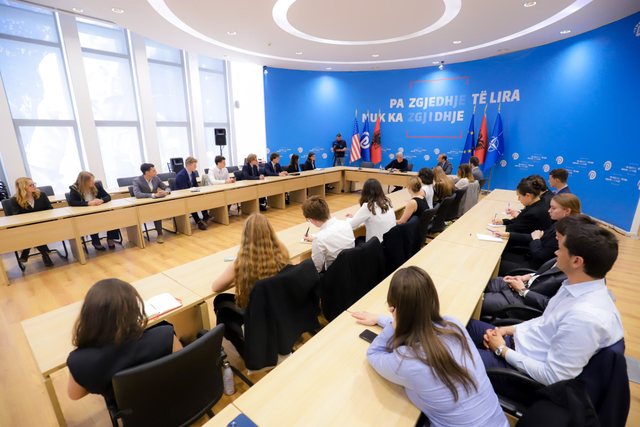
The Chairman of the Democratic Party, Prof. Dr. Sali Berisha, held a meeting with students from the French school, Sciences Po, where the focus was on corruption, the economy and Albania's European integration.
During the conversation, Berisha stated that the fight against corruption requires structural reforms, mentioning the facilitation of administrative procedures, the reduction of taxes and the use of technology to increase transparency in public procurement.
He criticized current practices in tenders, which discourage the participation of companies from European Union countries and contradict the principles of the common market and the rule of law.
Regarding regional developments, Berisha opposed any idea of "differentiated integration", commenting on a common position of Edi Rama and Aleksandar Vučić, while emphasizing that the future of Albania and the Balkans remains EU membership.
Berisha also called for transparency and a full investigation into issues of public interest, as well as greater appreciation for figures like Havzi Nela.
I had the pleasure of welcoming, in a long and extensive conversation, students from the prestigious French school of political studies, Sciences Po.
With young people, mainly French, but also from other European nationalities, we discussed current events in Albania: the repeated corruption scandals, the European integration process, as well as the challenges of the Balkans, including demography.
To their question about how the Democratic Party of Albania will fight corruption, I replied that this requires a combination of structural reforms: reducing the burden of licenses, the regular functioning of the "one-stop-shop" system, tax reduction, and the use of technology such as blockchain for transparent and traceable public procurement.
In the discussion on the economy, I emphasized that current practice often discourages the real participation of European companies in public tenders in Albania. This contradicts the spirit of the European common market and the principle of the rule of law. Without these two pillars, we cannot talk about true integration.
In this context, I also mentioned the joint letter of Edi Rama and Aleksandar Vučić in the German media, which suggests an approach that could be perceived as differentiated integration. This is not the standard we aim for. I repeated to them, as I do constantly, that the future of Albania and the Balkans is, without a doubt, in the European Union.
When asked about the positions of 'some lobbied Ambassador', who claims that the opposition is amplifying corruption scandals, I replied that there are those who passionately defend Edi Rama, but the assessment of reality must be based on facts and public interest, above any other consideration.
I also focused on the case of the College of Europe, emphasizing that any matter of public interest requires transparency and a full investigation, in accordance with European standards.
In the discussion on post-communist memory, I brought up the example of Havzi Nela — a poet who was tragically executed by the hand of Edi Rama's father and who deserves more recognition at the European level.
SciencesPo students are part of the Institute of Political Studies, East European Studies cycle, which includes some of the best professors and experts in Europe on integration.
The head of the cycle is also the Director of the Jacques Delors Centre for EU Enlargement.
Happening now...





ideas
Silence as a policy and fear as a system
Nga Sokol Neçaj
Is Spiropali a "Magyar", facing the autocrat Rama?!
Nga Neli Demi
American Libra!
Nga Arian Galdini
top


Alfa recipes







services
- POLICE129
- STREET POLICE126
- AMBULANCE112
- FIREFIGHTER128