


FLASH NEWS
The rise and fall of comrade Edi

2026-06-18 19:01:16 / IDE
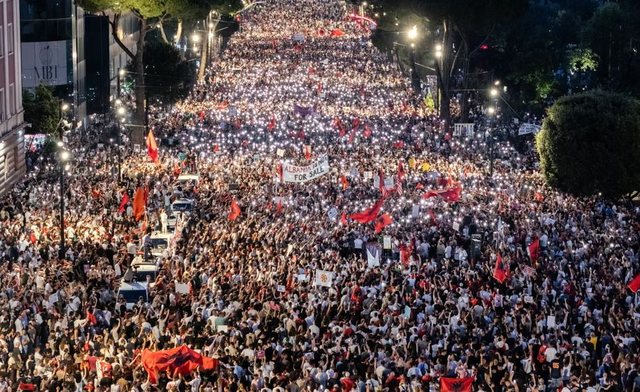
The Flamingo Revolution has already claimed its first victim – the aura and image of Edi Rama. Today his sneakers are old-fashioned and “cringe”, while his jokes are irrelevant and decadent. Once Edi Rama was the personification of everything Albania wanted, today he is the personification of everything Albania wants to free itself from.
What makes a person successful? The answer depends on the profession the person practices. For example, the main measure of an entrepreneur’s success is money. The more money, the more successful the entrepreneur is considered. Thus, we all experienced history these days when Elon Musk managed to become the world’s first trillionaire. But in politics, on the other hand, the most important currency is not money, but trust. So, we measure the success of any politician based on how much citizens trust a political leader – the more trust in a politician, the more successful he is considered. What my generation calls confidence, Generation Z would probably call “aura.” And based on this currency, politician Edi Rama's aura is in big trouble these days.
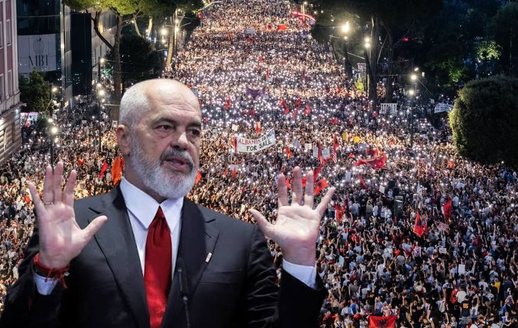
Over the past few days, hundreds of analyses have been written to explain the Flamingo Revolution – from science fiction conspiracies about foreign intervention, to more reasonable ones that explained the governing sins of Edi Rama. And of course, this is one way of seeing things. After more than a decade in power, the list of Rama’s sins is very long – election manipulation, repression of political opponents, capture of public institutions, “plata o plomo” of the media, international lobbying with the FBI, creation of ultra-oligarchs, proliferation of narco-cities, healthcare collapse, hyperinflation, incinerators, environmental destruction and concreting of the coast, 30 thousand euro wines, and the list goes on.
All of this and much more certainly explains why tens of thousands of Albanian citizens are gathering in Tirana’s squares every evening, but there is a more elegant and simpler explanation for the Flamingo Revolution. To borrow from Generation Z, Rama’s “aura” is over.
What Generation Z calls political “aura,” Max Weber called “charisma.” According to one of Weber’s theories, when a society reaches a point of political catharsis and social fatigue, it generates impersonal structural forces that create the conditions for the emergence of a “charismatic leader” who personifies all the hopes and dreams of a society.
Such a leader does not derive his power primarily from his ideas or policies, but from his charisma and aura. He attains almost semi-divine qualities. His name is chanted in the streets and squares, while his image is projected in concerts and stadiums.
An America tired of the fiasco in Iraq, Afghanistan and the financial crisis gave birth to Barack Obama. A Hungary tired of Orban's autocracy, oligarchy and degradation gave birth to Peter Magyar. A Kosovo tired of state capture and corruption gave birth to Albin Kurti. And an Albania tired of Sali Berisha gave birth to Edi Rama.
Edi Rama was a typical example of Weber's "charismatic leader". For decades, Albania had been tired of typical Balkan politicians. Although the years of Sali Berisha's government were characterized by historic developments such as visa liberalization and NATO membership, back in Tirana, Vlora and Dibër, Albanian citizens had become fed up with the government's inability to improve their daily lives. In other words, Albanian society had reached the point of political catharsis and social fatigue and was looking for a new politician who would give Albania a new renaissance. That person was Edi Rama. The antithesis of the classic Balkan politician - with a different vocabulary, a different demeanor, a different dress, and different tastes, Edi Rama was the change that Albania was looking for. For his transformation of Tirana, he would be declared the best mayor in the world and would be honored by Harvard. For the urban renaissance and transformation of Albania, he will secure a regular seat in important international forums and will significantly advance Albania's European position. In other words, Rama was not just a politician, he was a kind of global pop star. In the vocabulary of Generation Z, his aura was “+1000”.
But as Weber teaches us, and as every global pop star understands – aura is fleeting. The Albania of 2026 is not the Albania of 2006. What was once a symbol of change has become a source of frustration. Not because Edi Rama has necessarily changed, but because Albania has changed. Its emotional needs, its political expectations, and its economic demands have changed. Political leaders rise and fall as a result of forces they cannot control. Like supernovas, the forces that once created Edi Rama are now his destroyers. The Flamingo Revolution has already claimed its first victim – Edi Rama’s aura and image. Today his sneakers are old-fashioned and “cringe”, while his jokes are irrelevant and decadent. Once Edi Rama was the personification of everything Albania wanted, today he is the personification of everything Albania wants to free itself from. In other words, we are on the eve of the birth of a new Albania. Now, in this moment of political catharsis and social fatigue, Albania is searching for a new rebirth, a new Edi Rama. Rama can help this process or be consumed by it. The choice is his.
Happening now...







Attacks on Dumani and Berisha's silence on Ilir Shtufi
Nga Bato Kosova
ideas

The rise and fall of comrade Edi
Nga Demush Shasha

The Alliance of Seals and Towers, facing the New Republic
Nga Azgan Haklaj

The beginning of the end of power in Albania...
Nga Veton Surroi
top


Alfa recipes



TRENDING 




services
- POLICE129
- STREET POLICE126
- AMBULANCE112
- FIREFIGHTER128