


FLASH NEWS
Bosnia and Croatia sign agreement on gas pipeline to be built by Americans

2026-04-28 19:37:11 / BOTA
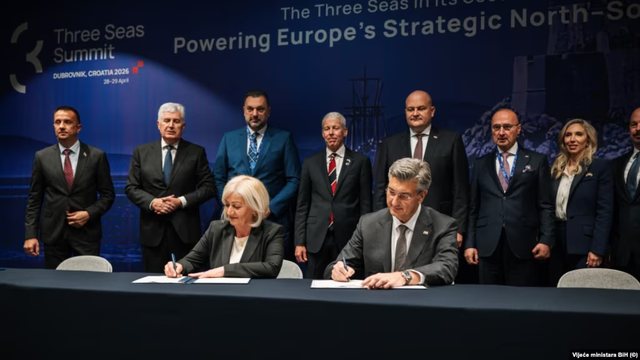
Bosnia and Herzegovina and the Republic of Croatia signed an interstate agreement in Dubrovnik on Tuesday for the construction of the "Southern Connection" gas pipeline, a project that aims to connect the two countries and provide Bosnia and Herzegovina with access to new sources of liquefied gas supply through the terminal on the island of Krk, HRT reported.
The agreement was signed on April 28 by the President of the Council of Ministers of Bosnia and Herzegovina, Borjana Kristo, and Croatian Prime Minister Andrej Plenkovic, within the framework of the Three Seas Initiative forum, a platform that brings together countries between the Baltic, Adriatic and Black Seas.
The initiative is supported by the United States with the aim of strengthening energy, transport and digital connectivity in the region. The American delegation in Dubrovnik is led by US Secretary of Energy Chris Wright.
The Southern Gas Interconnection project envisages the construction of a gas pipeline from Zagvozd (Split) in Croatia, through Posusje in Herzegovina, to Travnik in central Bosnia, with a branch towards Mostar.
With this signed document, Bosnia and Herzegovina and Croatia regulate issues such as the connection of the gas pipeline at the border, but also rights and obligations both during construction and in the event that one party withdraws from the agreement.
Croatia is expected to build a section of the route with a length of about 60 kilometers, while Bosnia and Herzegovina will build about 120 kilometers of pipeline.
The estimated value of the project is around 1 billion euros.
The pipeline would be integrated into the Croatian system, which is connected to the liquefied natural gas (LNG) terminal on the island of Krk, a key infrastructure for diversifying gas supplies, built with the support of the European Union.
The agreement between Bosnia and Herzegovina and Croatia was further harmonized on April 27, and a few hours before the signing in Dubrovnik, it was approved by the Council of Ministers of Bosnia and Herzegovina and the Presidency of Bosnia and Herzegovina.
After signing, the document must be ratified in the Assembly of Bosnia and Herzegovina and the Croatian Sabor.
The project is being developed within the framework of a broader goal to reduce Bosnia and Herzegovina's complete dependence on Russian gas, which is supplied to the country through Serbia via the TurkStream.
Bosnia and Herzegovina has been buying Russian gas since 1979, when the only existing gas pipeline from Belgrade to Sarajevo was built.
Although it was initially planned that the project in Bosnia and Herzegovina would be led by the public company BH-Gas, owned by the Government of the entity of the Federation of Bosnia and Herzegovina, the implementation was carried out by a special law involving the private American company AAFS Infrastructure and Energy, established at the end of last year.
According to available data, the director of AAFS Infrastructure and Energy is Jesse Binnall, a former member of US President Donald Trump's legal team, while the vice president is Joseph Flynn, the brother of former US national security adviser Michael Flynn.
The American company is expected to take over financing, design the main project and secure permits, as well as be the operator of the gas pipeline, while BH-Gas is legally obliged to submit existing documentation.
By law, the project has been declared strategic and of public interest, obliging local self-government units to make their land available without compensation.
The US Embassy in Sarajevo has publicly supported the project and participated in connecting local officials with representatives of the US company.
The European Union has previously warned that the legal framework, which establishes a private American company as the lead investor, could affect Bosnia and Herzegovina's European path, as well as access to around 1 billion euros earmarked for infrastructure projects under the EU's Growth Plan for the Western Balkans.
Bosnia and Herzegovina currently has no gas production of its own and is completely dependent on imports from Russia, with an annual volume of around 225 million cubic meters, according to data from the state statistics agency.
Payments to Gazprom are estimated at around 75 million euros per year. To make the pipeline economically viable, the construction of three gas-fired power plants is also planned.
The European Union plans to gradually phase out Russian gas imports by 2028, as well as gradually eliminate the use of fossil fuels and increase electricity production from wind farms and solar power plants, while gas is considered a transitional solution.
Coal, from which Bosnia and Herzegovina provides about 80 percent of its electricity, is expected to be phased out by 2050, something that Western Balkan countries aiming for EU membership have also pledged to do.
The gas network in Bosnia and Herzegovina is about 240 kilometers long and is considered underdeveloped. It is mainly limited to the capital Sarajevo, where gas is used for heating during the winter, along with some industrial consumers, while neighboring countries, Croatia and Serbia, have about 2,500 kilometers of pipelines each./REL
Happening now...










ideas



top











services
- POLICE129
- STREET POLICE126
- AMBULANCE112
- FIREFIGHTER128