


FLASH NEWS
Shocking discovery in Antarctica: Thousands of penguins at risk of freezing due to shrinking ice space

2026-02-26 17:43:37 / MISTERE&KURIOZITETE
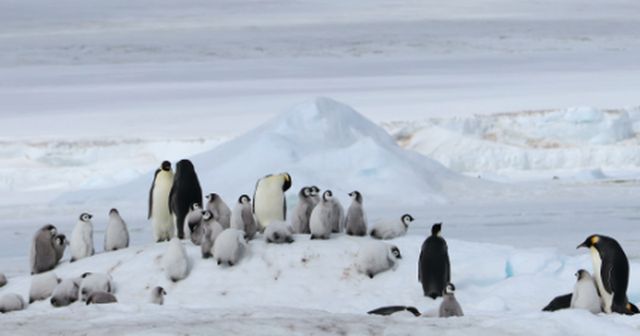
Alarm in Antarctica, thousands of emperor penguins may have frozen after ice disappears
A shocking discovery by scientists shows that a vital process for Emperor penguins is becoming a serious threat to their survival, as Antarctica faces dramatic consequences from global warming.
Every year, emperor penguins spend 30-40 days in an intensive process called molting, during which they lose old feathers and grow new, water-resistant ones.
During this period, they cannot enter the water, as they risk freezing to death. For this reason, they need stable sea ice platforms.
But in 2022-2024, sea ice in Antarctica shrank significantly, reaching record low levels.
In 2023, the area fell from an average of 2.8 million km² to just 1.79 million km². As a result, many colonies were left without safe places to complete the vital process of moulting.
The study, published in Communications Earth & Environment and led by Dr. Peter Fretwell of the British Antarctic Survey, shows that most penguin groups in West Antarctica, an area that accounts for 30-40% of the global population, are no longer appearing in satellite images.
"That was an 'Oh my God' moment," said Fretwell, who has been studying penguins for 20 years.
Instead of hundreds of groups, he managed to identify only 25, ranging in size from 10 to 1,000 birds.
Scientists suspect that thousands of penguins may have died after being forced into the water before their new feathers were fully mature.
Others may have moved towards East Antarctica, but this would have interrupted the breeding cycle, bringing other long-term consequences for the population.
The process of changing feathers is extremely tiring, birds lose up to 50% of their body mass during this time. Without their waterproof “suit”, they are extremely vulnerable.
According to researchers, these developments could accelerate predictions of a drastic decline or even extinction of emperor penguins in the coming decades.
The findings are a clear warning that climate change is not always gradual, sometimes it brings dramatic turns that change the fate of a species within a few years./TAR
Happening now...
















ideas



top



Alfa recipes








services
- POLICE129
- STREET POLICE126
- AMBULANCE112
- FIREFIGHTER128