


FLASH NEWS
What is the "Flag of Vengeance" and why was it raised in Iran after the Israeli attack?

2025-06-13 23:29:35 / BOTA
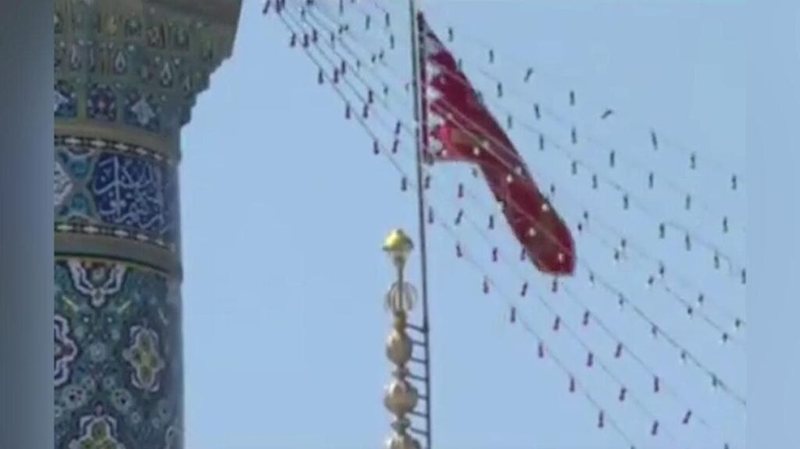
It has not escaped the attention of many analysts that one of Iran's immediate actions after the Israeli attack did not have a political, diplomatic, or military dimension, but was a purely symbolic act.
Above the dome of the Jamkaran Mosque, one of the most important holy sites there, is the so-called “Banner of Vengeance.” A red cloth on which is written a call in Arabic to the avengers of Hussein, killed on October 10, 680 during the famous Battle of Karbala, one of the founding events of Shiite doctrine that directly influences the Iranian ruling class today.
Hussein, the grandson of Muhammad, was the protagonist of a brief episode of rebellion that had extraordinary historical consequences. At the heart of this event lies the great clash between the Shiites, who supported the right of the direct descendants of the Prophet to lead the Islamic community, and the Umayyad (and Sunni) Caliphate of Damascus.
When the Shiites of the Iraqi city of Kufa rose up against the Umayyads, Hussein, with a small group of family and supporters, decided to join the revolt, but was confronted by Umayyad troops at Karbala, near the Euphrates. The account of what happened is filled with symbols and elements of religious tradition.
According to tradition, the commander of the Sunni troops, reluctant to face the Prophet's grandson in an unequal battle, tried to persuade Hussein to retreat, but the latter was adamant. At dawn on Friday, the tenth day of the Islamic month of Muharram, the battle began.
The heat was stifling and the Shiite troops suffered terribly from thirst. Hussein saw all his companions fall around him: only his family members remained. One of his sons was torn to pieces by the enemy crowd, causing his father to despair. The massacre continued with macabre episodes: Hussein, exhausted by thirst, fell face down on the ground holding his one-year-old child in his arms. The enemies approached, but no one dared to kill the Prophet's grandson.
An arrow struck the child in the ear, killing him. Hussein ran to the banks of the Euphrates, stooped to drink water, and was struck by arrows. Covered in blood, he managed to kill several enemies, but was covered in wounds. Finally, he was shot in the back. His head, severed from his body, was sent to the Umayyad caliph Yazid. For this reason, Shiites swear revenge against the killers of the Prophet's grandson until the end of time.
This narrative is based on a very broad religious and legendary tradition that centers on the theme of the assassination of the "cultural hero" Hussein, who is sacrificed for humanity.
The tragedy of Karbala is experienced and commemorated every year by the entire Shiite movement. In many countries, religious performances or processions similar to those of the Christian Holy Week are organized. The sacrifice of Hussein is also a political act: the believer learns from it that it is a duty to rise up against tyrants and injustice, not for personal gain, but for the good of the community.
Karbala also marks a turning point in the transformation of Shiism into a movement that, in addition to political supporters, will also absorb enthusiastic bearers of gnostic, messianic and syncretic ideas, foreign to the Islamic tradition. In this way, the movement will be colored by "extreme" theological tendencies, dividing into sects and sub-sects that, in some cases, exist to this day.
In light of all this, the content of Iran's message to its enemies becomes clearer.
A typical element of Shiite doctrine, which it shares with Christianity, is the reevaluation of pain and suffering as positive values. As the great Islamologist Alessandro Bausani has written, “ Shiism, whose leaders, except for a few brief periods and rare exceptions, never managed to seize the power that, according to their followers, rightfully belonged to them, is a religion of the defeated who dream of revenge.”
It must be understood that what may seem like just old stories to us still continues to influence the political and religious ideology of the Iranian ruling class, but also of a large part of the Persian people.
The possibility of defeat, even complete destruction, is accepted, but this does not mean surrender.
It is a hopeless struggle (which finds its reward in a supernatural dimension), but which for this very reason can become merciless.
Maybe it's time to stop, before it's too late.
Source: " La Republica "
Happening now...









America may withdraw from Europe, but not from SPAK
Nga Gentian Gaba
ideas

Who is the Surrel Rabbit?
Nga Sidi Hasanaj

The two wrong paths of the opposition with the Ombudsman
Nga Patrik Sadikaj
top



Alfa recipes


TRENDING 




services
- POLICE129
- STREET POLICE126
- AMBULANCE112
- FIREFIGHTER128