


FLASH NEWS
Theories about the disappearance of the lost city of Atlantis

2024-06-04 15:57:45 / MISTERE&KURIOZITETE

The story of the lost island/continent of Atlantis has been told since at least 2,300 years ago by the Greek philosopher Plato, who said that the advanced city of the ancient civilization was destroyed and sunk under the Atlantic Ocean.
It is not clear whether the Greeks of that era took Plato's account for granted, or as a metaphor for the collapse of successful civilizations that have existed throughout history.
Whatever happened, the issue remains a hot debate among scientists, historians and philosophers about past history, and the parts removed or added to it over the decades, according to the convenience of the factors in power.
The British network MailOnline compiled five main theories about the Lost City, which include its "swallowing" by the Bermuda Triangle, or the idea that it never existed.
The theory of the absorption of civilization by the Bermuda Triangle comes after the area also known as the Triangle of unexplained disappearances of several ships over the years.
This piece over the Atlantic Ocean is reported to be responsible for the mysterious disappearance of about 50 ships and 20 planes.
In his book "Continent Revealed", Charles Berlitz writes that this could be an explanation for the disappearance of the ancient civilization, adding that Atlantis was a small continent off the coast of the Bahamas.
Supporters of this theory cite the existence of an "underwater road" known as the Bimini Road, discovered north of the island of Bimini in the Bahamas.
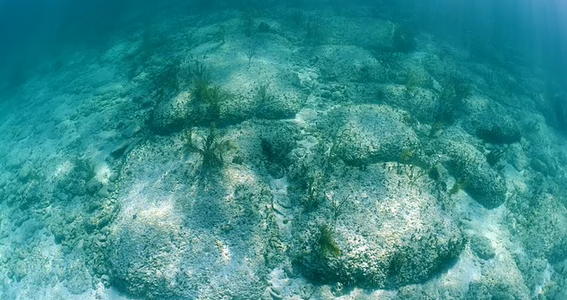
Bimini Road
The underground rock formation is almost a km long and consists of limestone blocks.
The Bimini Pass was also mentioned by the American philosopher Edgar Cayce, 30 years before its discovery in 1938.
Researchers say the data has revealed that the structures may have been formed by the gradual erosion of limestone as Atlantis was destroyed in a natural disaster.
One theory that continues to be repeated about the destruction of Atlantis is that a volcano erupted on the Greek island of Santorini (known as Thera) about 3,600 years ago.
The lava eruption is believed to have created a "cauldron" under Santorini causing large land masses to sink.
The ancient Minoan civilization that lived at the time in Thera, was believed to be among the first and most advanced in Europe to have built roads and palaces, and used a written language.
Archaeologists believe that the Minoans were a skilled and intelligent people who lived by fishing and trading with other Mediterranean countries.
During the construction of this successful civilization, the island was suddenly destroyed, which brought about the connection of the event with Plato's theories.
Another mystery theory is that Atlantis was actually Antarctica itself.
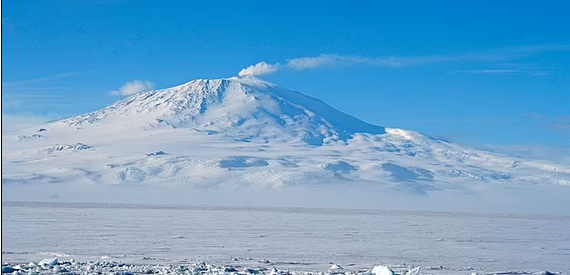
Antarctica, suspected location of Atlantis
The theory suggests that Atlantis was actually a warmer version of the icy continent of Antarctica that exists today.
This is largely based on Charles Hapgood's 1958 book, 'Earth's Shifting Crust', which disproves the theory of continental drifts, before accepting the current theory of plate tectonics.
It suggested that the earth's crust had shifted about 12,000 years ago, causing Antarctica to move further south from its position in the Atlantic.
Supporters of the theory say that the famous city is already buried under many layers of ice, while others say that if the Antarctic is searched there may be signs of life and civilization.
In 2017, the discovery of a hydraulic system in several layers of ice under Antarctica led people to believe that it was evidence of the discovery of Atlantis.
Scientists say they have discovered giant structures in the ice layers, some of which are bigger than the Eiffel Tower, writes the Daily Mail.
Another theory says that Atlantis was destroyed by a meteorite impact.
Although it has been called one of the most absurd theories, in a documentary by the British writer Graham Hancock it is said that Atlantis was destroyed by a tsunami and the flood caused by the meteor.
Many scholars have disputed it, seeking evidence for the claims.
Archaeologist Flint Dibble told The Conservation Network: "Hancock presents himself aggressively to the scientific community, so I wonder if they're reacting or trying to attract a conspiracy community.
While the theory that Atlantis never existed is supported by theorists who say that Plato's stories were fictional, even though he is considered one of the greatest philosophers of all time.
Scholar Alan F Alford said in 2001 that Atlantis may be a myth created by Plato.
"Atlantis could be a lost paradise, an island or a continent, but it could also be a symbol for an important event that happened, which somehow disturbed the universe. Plato is the only authority on history, and to ignore him is to create your own myth."
Happening now...















America may withdraw from Europe, but not from SPAK
Nga Gentian Gaba
ideas



top


Alfa recipes




TRENDING 




services
- POLICE129
- STREET POLICE126
- AMBULANCE112
- FIREFIGHTER128