


FLASH NEWS
What's on the dark side of the Moon? NASA hopes it holds the secret to life on Earth

2026-04-04 20:19:28 / MISTERE&KURIOZITETE
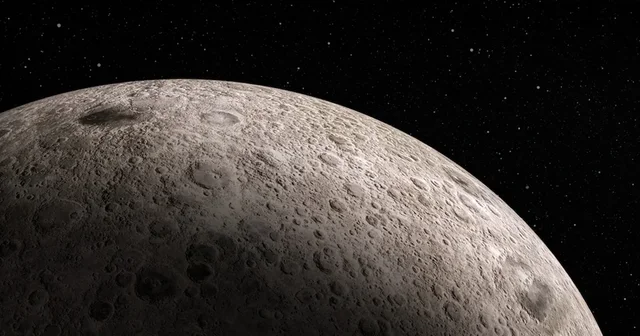
When the Artemis II astronauts reach the far side of the Moon, communication with Earth will be cut off because the Moon will block signals. During this interruption, which will last about an hour, three American astronauts and one Canadian will conduct scientific observations that could help understand the origins of life on Earth.
The view they will see is not like the smooth, bright disk we see from Earth. The far side of the Moon is covered with numerous craters and marks created by billions of years of asteroid impacts. These marks represent a natural archive of what Earth may have experienced in its early days, providing important clues about how life may have formed.
The astronauts were asked to focus on two features in particular: the Oriental Basin and the South Pole-Aitken Basin, the largest and perhaps oldest known crater in the Solar System. Both date back about four billion years, during a period called the Late Heavy Bombardment, when asteroids frequently struck the Moon and Earth. This period coincides with the time when life began to appear on our planet. One theory suggests that the first seeds of life may have come via these asteroids, and their traces may still be preserved in the craters on the far side.
According to astronaut Christina Koch, the Moon is like a "witness" that preserves the early history of the Earth, a history that on our planet has been erased by erosion and tectonic processes. Studying it can help scientists better understand the formation of the Solar System, the birth of planets and the possibility of the existence of life elsewhere.
Artemis II will fly much higher than the Apollo missions, about 7,400 kilometers above the lunar surface, giving astronauts a wider view and the opportunity to see areas that the human eye has never directly observed. Unlike Earth, where geological processes change and destroy rocks over time, the surface of the Moon has remained almost unchanged, preserving the ancient history of space.
The crust on the far side is thicker, which has prevented the craters from filling with lava and preserved them as a time capsule. Astronauts will particularly study the Oriental Basin debris rings, created about 3.8 billion years ago by the impact of a giant asteroid.
Equally impressive is the South Pole-Aitken Basin, about 2,600 kilometers wide, where scientists believe the iron-nickel core of an ancient asteroid embedded in the Moon may be found. Studying it could help determine when violent collisions in the Solar System calmed down and conditions became suitable for life on Earth.
NASA has ambitious plans for the future of this area. Its distance from Earth's electromagnetic noise makes the far side an ideal location for space telescopes, and two observatory projects are already in the planning stages. With humans returning to the Moon following the success of Artemis II, this mysterious side could soon become less remote for humanity. / The Telegraph
Happening now...















ideas

The alliance of citizens with SPAK is a historical imperative!
Nga Azgan Haklaj

Their time is up.
Nga Erl Kodra

Two sides of the same coin!
Taulanda Jupi
top


Alfa recipes







services
- POLICE129
- STREET POLICE126
- AMBULANCE112
- FIREFIGHTER128