


FLASH NEWS
From dogs to elephants: The phenomenon of animals "enjoying" the view of the sea

2026-04-04 20:43:31 / JETË
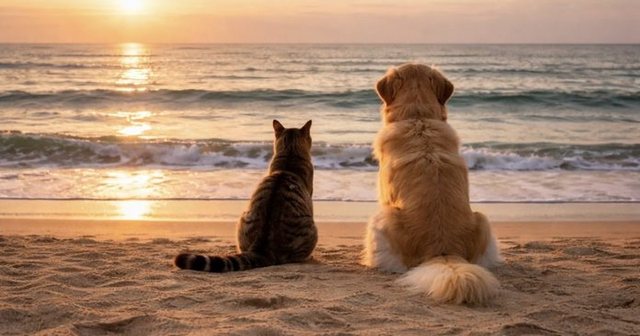
Many animals, from dogs to elephants, can stand for long periods of time, without moving, gazing out to sea, according to ScienceDirect.
Scientists think this behavior is a natural combination of curiosity and perception, helping animals gain information about their environment and perhaps reduce stress – similar to humans “finding peace” by looking at the sea – but what do scientists say?
The research, "Observing animals and people: dogs direct their gaze towards biological information in natural landscapes," was conducted at the University of Helsinki, Finland.
The study analyzes how dogs navigate natural landscapes through sight.
Research on curiosity and perception
Animal behavior scientists have discovered that curiosity is a powerful motivator in animals, and not just humans.
These behaviors of staring deeply at something that does not bring immediate benefit may be related to how animals process information in their environment — assessing location, danger, or simply taking in “perceptual data” about what is happening around them.
The sea, with its uninterrupted horizon and rhythmic waves, offers a serene and vast visual vista – where there is no immediate danger such as predators or hidden prey.
This may allow animals to follow distant visual stimuli without being distracted by numerous surrounding objects.
Although there is no specific research identifying why animals gaze at the sea to find calm, similar behaviors in animals are often associated with assessing the environment for safety and orientation strategies, and not necessarily with the same emotions that humans experience.
Visual behavior in terrestrial mammals
Studies on mammals like dogs show that animals direct their gaze towards the most interesting or informative object in the environment – often animals that see other living figures look longer than motionless backgrounds.
This means that a wide horizon, like that of the sea, can be a clear and interesting stimulus for calm observation.
Animals perceive their environment differently than humans. Many species use not only vision but also hearing, smell, and other senses to "read" the world around them - especially in a habitat like the sea.
Animal experiences are not identical to humans. Terms like "calm" or "relaxation" in humans are associated with more complex emotions.
However, for animals, standing still – looking at the horizon – is more often related to environmental information, orientation and risk assessment, and not a psychological need as it is with humans.
Happening now...















ideas

Renaissance is Disaster Capitalism
Nga Klodian Tomorri

Pse tifozeria e Kosovës ishte aq e vdekur dhe mungonin simbolet kuqezi?
Nga Kreshnik Spahiu

top



Alfa recipes



TRENDING 




services
- POLICE129
- STREET POLICE126
- AMBULANCE112
- FIREFIGHTER128