


FLASH NEWS
The hidden detail in Leonardo da Vinci's scrotum solves a 500-year-old mystery

2025-10-28 19:29:43 / MISTERE&KURIOZITETE
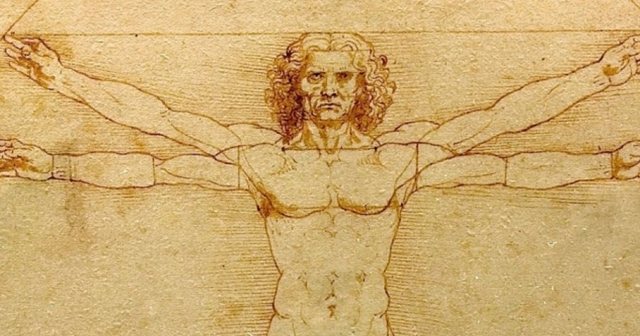
Leonardo da Vinci, the famous Italian scholar who painted the Mona Lisa, had an extraordinary understanding of geometry well ahead of his time.
To draw the Vitruvian Man in 1490, an illustration of the "ideal" human body, the Renaissance artist may have used a mathematical ratio that was not formally defined until the 19th century.
It's one of the most iconic images of all time, and yet for more than 500 years no one could understand why da Vinci had chosen such particular proportions for the arms and legs.
As revealed in a paper published this year, a London dentist believes he has finally solved this mystery.
Rory Mac Sweeney has discovered a hidden detail in the scrotum of the Vitruvian Man: an equilateral triangle that, according to him, could explain "one of the most analyzed and enigmatic works in the history of art."
The Vitruvian Man is partly inspired by the writings of the Roman architect Vitruvius, who argued that the perfect human body should fit within a circle and a square.
Da Vinci's drawing uses a square to accurately include a "cross-shaped" stance, with arms outstretched and legs together, while the circle includes another stance, with arms raised and legs spread.
A popular explanation is that da Vinci relied on the Golden Ratio Theory, but the measurements don't match up completely.
According to Mac Sweeney, "the solution to this geometric mystery has been right before our eyes all along."
In his notes on the Vitruvian Man, da Vinci wrote: "If you spread your legs… and raise your hands so that the extended fingers touch the line at the top of your head… the space between your legs will form an equilateral triangle."
When Mac Sweeney did the calculations for this triangle, he found that the distance between the legs and the height to the navel created a ratio of approximately 1.64 to 1.65.
This is very close to the tetrahedral ratio 1.633, a unique and balanced geometric shape, officially defined in 1917.
This ratio is used to determine the most efficient way to stack spheres. For example, if four spheres are stacked as tightly as possible in a pyramid shape, the ratio of the height to the base from their centers is 1.633.
Perhaps Mac Sweeney recognized the importance of this number thanks to a similar triangular principle used in dentistry since 1864.
In the human jaw, Bonwill's triangle determines the optimal position for its functioning, and its ratio is also 1.633.
Mac Sweeney doesn't think this is a coincidence.
As in nature's minerals, crystals, and biological systems, he believes that the human jaw is naturally organized according to tetrahedral geometries, which maximize mechanical efficiency.
If this ratio is repeated in other parts of our body, Mac Sweeney thinks it's because "human anatomy has developed according to geometric principles that govern optimal spatial organization throughout the universe."
If he is right, then da Vinci may have accidentally stumbled upon a universal principle while drawing the Vitruvian Man.
"The same geometric relationships that appear in crystal structures, biological architectures, and Fuller's coordinate systems seem to be embedded in human proportions," writes Mac Sweeney, "suggesting that Leonardo had intuitions about fundamental truths about the mathematical nature of reality itself."
Whether other scientists will agree with Mac Sweeney remains to be seen, but the fact that da Vinci mentions the equilateral triangle in his notes shows that what is between the Vitruvian Man's legs does indeed matter.
Happening now...















ideas



top






TRENDING 




services
- POLICE129
- STREET POLICE126
- AMBULANCE112
- FIREFIGHTER128