


FLASH NEWS
Osmani at the EU-Western Balkans summit: the EU is doing injustice to Kosovo

2024-12-18 18:49:36 / KOSOVA
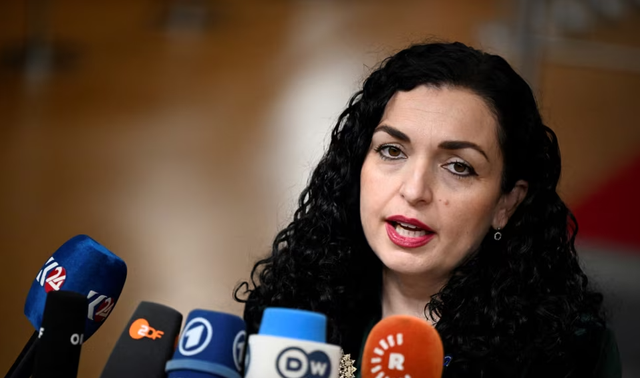
The President of Kosovo, Vjosa Osmani, has criticized the European Union for being "unfair" towards Kosovo in its policies in the Western Balkans, not removing the punitive measures against it and showing no willingness to consider its request for membership in block.
Speaking after arriving in Brussels on Wednesday for the EU-Western Balkans summit, Osmani said that "it seems that there are tendencies in the EU from some member states for Kosovo to be constantly punished".
She said that meetings like this summit are a good opportunity to advance the European perspective of the entire region, but that, according to her, in the process of enlargement, the EU is doing "injustice" to Kosovo.
Kosovo has applied for membership in the European Union on December 15, 2022, but its request has not yet been approved, and as a result it is the only country in the Balkans that still does not have the status of a candidate country.
Osmani insisted that if there is political will on the part of the EU, modalities can be found to mandate the European Commission to examine Kosovo's application for membership.
Osmani also spoke about the issue of the EU's punitive measures against Kosovo, saying that, in addition to being "unfair", they are also "un-European" because, as he said, "they are punishing a people with 1.7 million inhabitants, which is the most pro-European nation on earth, with over 97 percent of its citizens supporting the EU integration process".
The European bloc imposed punitive measures against Kosovo in 2023, after the increase in tensions in the north of the country. The EU has assessed that the Government of Kosovo has not done enough for expansion.
Meanwhile, the head of European diplomacy, Kaja Kallas, said before the start of the summit that the Western Balkans is very important for the EU and that geographically it belongs to Europe.
"It is clear that the European Commission, together with me, really wants to see progress in the enlargement process during the next five years of my mandate. We are ready to work on this", said Kalas.
The President of Montenegro, Jakov Millatovic, said that his country is a "leader" in the membership negotiations and that his ambition is to become the newest member of the EU.
"We have set a very ambitious target to become the 28th member state by 2028. This is an ambitious goal, but in our opinion, still achievable. And we believe that by becoming a part of the EU, Montenegro can together send a very strong, clear and positive message to everyone else, to all the other candidate countries, that enlargement is still possible. alive", said Millatović.
Montenegro has opened all negotiation chapters and temporarily closed six, after starting membership negotiations in 2012.
On the other hand, the president of Serbia, Aleksandar Vučić, said that he expects good talks during the summit, but added that he does not have great expectations from this meeting.
"It's good that we can respond to the untruths that some will definitely say about Serbia, and that's it," said Vučić before the start of the EU-Western Balkans summit.
So far, Serbia has opened 22 out of a total of 35 chapters of negotiations for membership in the European Union. Of those 22, it has temporarily closed 2. However, the negotiations between Belgrade and Brussels have been practically frozen for three years now, due to the non-imposition of sanctions against Russia.
The leaders of the member countries of the European Union gathered in Brussels with their colleagues from the Western Balkans in the joint summit that has already become the regular format of meetings at least once a year.
The purpose of the EU-Western Balkans summit, according to the bloc's officials, is to strengthen the partnership between the European Union and the countries of the Western Balkans by including the gradual integration of these countries into some EU policies even before they become formalized one day. member countries.
The message is expected to be sent from this summit that the EU will treat the enlargement process as a high priority and express its interest in speeding up this process. This is also included in the text of the Joint Declaration prepared for approval at the summit.
"Enlargement is a geostrategic investment in peace, stability and prosperity. Now there is a new dynamism in the expansion process. Accelerating the enlargement process, based on fair and strict conditions and the principles of individual merit, is in the common interest", the draft of this document states.
The countries of the Western Balkans region will be called upon to resolve disagreements among themselves as well as with their neighbors in the EU, in order to speed up the enlargement process.
"Regional and bilateral disagreements that have their roots in the past, for a very long time, have hindered focusing on the future. The implementation of bilateral agreements in good faith and with tangible results, including the Prespa Agreement with Greece and the Treaty of Friendship, the Agreement for good neighborliness and cooperation with Bulgaria remain key," this document states.
In particular, Kosovo and Serbia will be called upon to advance in the process of normalizing relations between them by fulfilling the obligations arising from the dialogue, which is facilitated by the EU.
"The agreements reached within the EU-facilitated dialogue between Belgrade and Pristina, including the Agreement on the road to normalization, must be implemented without further delays. The EU invites all partners to guarantee the rights and equal treatment of persons belonging to minorities", it is emphasized in the draft text of the declaration.
The prime minister of Albania, Edi Rama, the president of Montenegro, Jakov Millatović, the president of Serbia, Aleksandar Vučić, the prime minister of North Macedonia, Hristijan Mickoski, and the head of the Presidency of Bosnia and Herzegovina will also be present at the summit from the Balkans. , Zheljka Cvijanovic.
In addition to the heads of state or government of EU member states, the president of the European Council, Antonia Costa, as the organizer of the meeting, then the president of the European Commission, Ursula von der Leyen, the president of the European Parliament, Roberta Metsola, also participate in the meeting. , and the High Representative of the EU for Foreign Policy and Security, Kaja Kallas./REL
-

Weapons and ammunition are seized in Pristina, several people are arrested
December 18, 18:39
Happening now...


America may withdraw from Europe, but not from SPAK
Nga Gentian Gaba
ideas

Who is the Surrel Rabbit?
Nga Sidi Hasanaj
The two wrong paths of the opposition with the Ombudsman
Nga Patrik Sadikaj
top
Alfa recipes

TRENDING 




services
- POLICE129
- STREET POLICE126
- AMBULANCE112
- FIREFIGHTER128