


FLASH NEWS
The archeological findings in Struga belong to the Illyrian tribe of Enkeleids

2024-11-09 19:49:31 / JETË
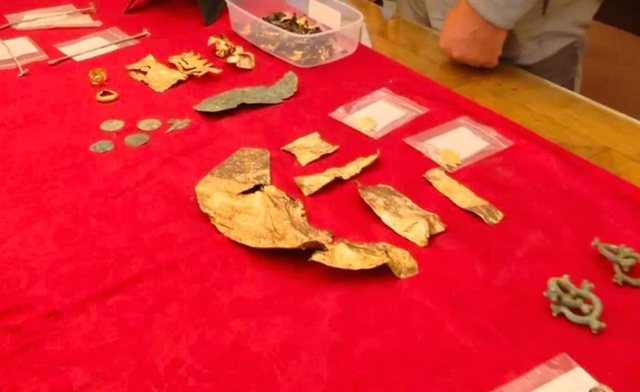
The archaeological discoveries in Struga, namely in the Albanian village of Koroshishte, which were presented yesterday by the Minister of Culture and archaeologists, are from the 6th century BC. The bronze helmet, gold rings, various dishes, gold metal sheets, but also various shapes and decorations have been found within a set of cemeteries which have been traced since 2023 when the team led by Pero Arxhanliev e has received permission to track. However, everything started in 2020, when Shefit Shemshedini from Koroshishta in Struga came across stones while working his field, and then he discovered a bronze helmet, which he handed over to the Ohrid Museum. The findings, although not highlighted in the announcement of the Ministry of Culture, according to archaeologist Fitni Dalipi, belong to the Illyrian tribe of the Enkelejds, who lived in the regions around Lake Ohrid and who created the first dynasty of the Illyrian kingdom at the end of the 5th century BC. Christ.
"Over 100 artifacts have been found here since we finished the excavations. We came to the conclusion that these artifacts belong to the population that lived in the basin of Lake Ohrid, Ohrid, Struga Pogradec. They are the Enkleid tribe. They are 2,600 years old", said Fitni Dalipi, Archaeologist.
The findings are defined in epochal proportions, something that, as Dalipi says, happens once every 100 years.
"We have linen, bronze, iron artifacts, we have silver and gold. That is, it is a very rich grave, which means that the population that lived in this area was a very economically strong population that had the opportunity to import objects from abroad", said Fitni Dalipi, Archaeologist.
The Minister of Culture, Zoran Lutkov, also spoke about the importance of the findings a few days ago, who first of all thanked the owners of the land, Bukuri Shemshedini and Shefit Shemshedini, who detected, denounced and helped in these excavations, which according to him are the greatest archaeological discovery in North Macedonia for the last 100 years.
The findings, according to the warning, will be conserved and sent to the Archaeological Museum of Skopje, as there are no conditions to keep them in the Ohrid Museum. What caught the eye and raises doubts in the opinion that the findings can be manipulated is the presence of Pasko Kuzman at the excavation site, the man who in 2016 was sentenced to prison on charges of mishandling and selling artefacts while he was the director. of Cultural Heritage Protection./ Alsat.mk


Happening now...













America may withdraw from Europe, but not from SPAK
Nga Gentian Gaba
ideas


Who is the Surrel Rabbit?
Nga Sidi Hasanaj

The two wrong paths of the opposition with the Ombudsman
Nga Patrik Sadikaj
top



Alfa recipes




TRENDING 




services
- POLICE129
- STREET POLICE126
- AMBULANCE112
- FIREFIGHTER128