


FLASH NEWS
Meeting to review the unifying decision on pre-trial detention, debates in the United Colleges are revealed

2026-04-09 12:20:29 / AKTUALITET
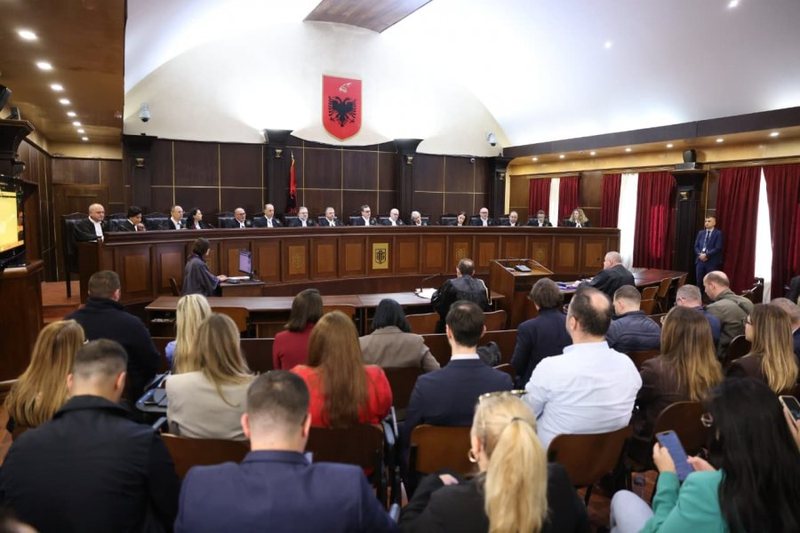
The United Colleges were summoned today by the President of the Supreme Court, Sokol Sadushi, to review the unifying decision of 2011 on the measure of securing detention in prison and its duration.
The session began at 09:30 and 16 Supreme Court judges are present.
After two hours of discussion, the meeting continued behind closed doors.
The unifying decision of 2011 has served for more than a decade in determining the security measure of “prison arrest”. Meanwhile, the interim decision under discussion requires a new interpretation of articles 228 and 230 of the Code of Criminal Procedure in accordance with the European Convention on Human Rights (ECHR), specifically analyzing three questions related to the determination of dangerousness, when alternative measures should be considered and how the risk of evidence destruction should be assessed.
Deputy Prosecutor General Arqile Koçi said that he agreed to some extent with standardization, but the Supreme Court must be careful.
Prosecutor Arqile Koça (Representative of the General Prosecutor's Office: The burden of determining the measure of detention in prison lies with the prosecutor. It cannot depend solely on the evidence of the defendant's behavior. They are assessed by the court in harmony with other evidence.
It is not in vain that in my first part I made an analysis on which we should base our decision. The ECHR and the practice in its implementation is above the Code of Criminal Procedure.
Judge Sokol Binaj: Let's clarify our Code first, then the Code of the ECHR
Arqile Koça: It has been determined that in order to impose imprisonment, one cannot proceed solely from the measure of punishment. This has been stated by the ECHR and the judicial practice of the Supreme Court. The particular dangerousness of the criminal offense and the perpetrator cannot be inferred solely from the margin of punishment for the criminal offense charged.
Judge Enton Dhimitri: The questions raised by the UN regarding the unification decision of 2011, you said that they do not come naturally, the question comes naturally, why do we need to change it. If the changes have been reflected, why do we need a change? If we accept the principle that the burden of proof lies with the prosecutor, for the measure, the prosecutor has an obligation for suitability, why should the court also have this object? Will we have a reversal of the burden of proof from the prosecutor to the court?
Prosecutor Arqile Koça: There is a different meaning at least with what is called the practice of the Supreme Court. I think this debate should be, whether the decisions are unifying or more than that. Although it is called unifying, how unifying and unifying are the relevant paragraphs. Some have the view that judicial practice is also if the Supreme Court holds the same and continuous position on a certain issue. Let's take into account the goals of what we need to achieve. I think they are positive but they should not hinder the achievement of the objectives in improving the legislation. The criminal system starts from the prosecutor, the prosecutor, the court. The court does not reach conclusions alone, the prosecutor does, if the prosecutor convinces him and convinces him, if not, it acts differently in the next conviction. We are afraid that we will move on to the other problem of violating the public interest. I represent the public interest, and I ask that we be careful. Okay, let's go out, but how do we make sure he comes to the court session? Beyond your concern that he might be right, I raise the prosecutor's concern.
Arqile Koça: We must keep in mind that the judicial decision is against a person and is the product of the collection of evidence and facts, not only legal by the prosecutor and the court, but also social, etc. I am afraid that if it is categorical, it will be very problematic.
Judge Arbena Ahmetaj: Should this list also be related to the personality of the person under investigation? Do you think that the burden of proof can be exercised only in the implementation of the first instance decision or also in other cases?
Arqile Koça: We cannot simply start from the magnitude of the crime committed, but also from other elements. Is the contribution to the criminal offense primary or secondary, what role does the person have in the offense? Courts in function of the defendants of each level have the right and obligation to verify as much as they can verify.
The measure of detention in prison is taken after a judicial debate. The verification is done in a debate session where the parties debate whether this measure should remain or not. Every two months the court is not limited. The court must reason more extensively. The Strasbourg standard says to the prosecutor "what have you done in these 3 months, why should the investigation be extended"? So I think the court should be more demanding. The principle is that only irreparable invalidities should be returned for retrial, the reparable ones are assessed and regulated in the same trial.
Happening now...















Denouncing Berishism is a prerequisite for denouncing the government
Nga Blendi Kajsiu
ideas

Cycle: Jobs for Albania! What did time prove to us for Air Albania?
Nga Irena Beqiraj

When cardboard and arrogance become law.
Nga Gjergji Nika

Renaissance is Disaster Capitalism
Nga Klodian Tomorri
top



Alfa recipes



TRENDING 




services
- POLICE129
- STREET POLICE126
- AMBULANCE112
- FIREFIGHTER128