


FLASH NEWS
The grotesque tragedy of the political death of the autocrat Berisha

2025-10-23 10:11:40 / EDITORIAL
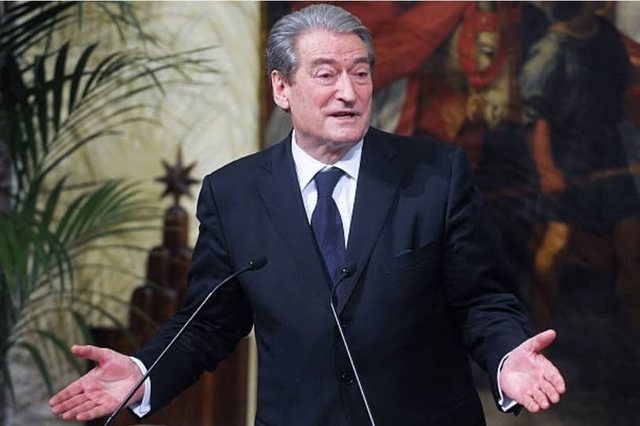
There is a kind of grotesque tragedy in the way an autocrat dies. He refuses to die as an ordinary man because he has never lived as one. Power for him is not a tool, but a vital organ. Giving up his chair, for him, is like asking him to stop breathing at will. Democrats should understand if they haven't already that Berisha is not fighting for power, but for the illusion of immortality. He sees himself as a statue that cannot be destroyed by time, and in every political blow he sees an act of blasphemy against the myth he has built for himself.
Political death, for him, is not the end of his career but an ontological insult, a kind of denial of existence. Thus, he climbs every morning on the ruins of himself as on an invisible throne and speaks in the former tone of power, as if time had stopped in the year when he commanded everything.
In fact, it is no longer he who rules the chair, but it is the chair that rules it.
The autocrat Berisha, tired of death, does not give up, because unlike ordinary people, he does not have an “other life” to return to. He only has power as eternity and the public as an open grave. He is no longer a leader, but a ghost who wanders between memory and farce, seeking to believe that applause still exists somewhere, perhaps in the echo of his own voice. Since autocrats do not die, they rot publicly. They hang on the microphone as if on breathing apparatuses, repeating words that once ignited the crowd, but now serve only as the voice of a corpse that does not accept the funeral. Instead of accepting the end with dignity, he chooses to remain suspended, between the history that has closed him and the reality that no longer loves him.
The crowd and the membership are not simply witnesses to this spectacle, but an organic part of it. They are nourished by his presence as much as he is by their adoration. In every remaining applause, he finds reason to believe that he is still alive politically, while they, in every performance of his, find an alibi not to change. There is a codependency between the leader who does not know how to leave and the followers who do not know how to free themselves from the myth. Thus, the party is transformed into a kind of ritual community, where loyalty replaces reason, and loyalty to memory becomes stronger than facing reality. In the end, it is not only the autocrat who does not accept death, but also the crowd that refuses life without him.
But every such spectacle has its audience beyond the party and its militants, the crowds who want to see the god die slowly. In this sense, Berisha is still useful as a reminder of a past that has not completely died and as a warning to a future that has learned nothing. He is, in essence, a self-aware relic, who knows he is fading, but prefers to fade under the camera lights.
Happening now...








ideas

Will the new justice system unite the SP and the DP?
Nga Arbër Hitaj

Sovereignty as a fig leaf
Nga Namir Lapardhaja

top






TRENDING 




services
- POLICE129
- STREET POLICE126
- AMBULANCE112
- FIREFIGHTER128