


FLASH NEWS
"Iron rain" and dust clouds! Scientists make unusual discovery

2025-06-10 22:00:45 / BOTA
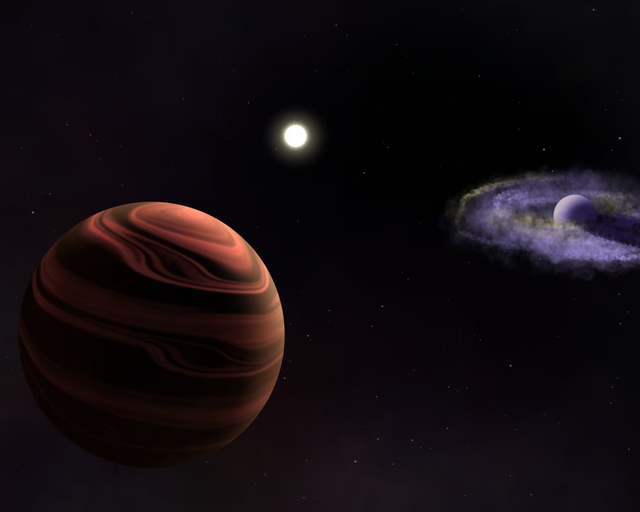
Imagine a planet where instead of water rain, molten iron falls from the sky. Sounds strange, doesn't it?! This is not a scene from a science fiction movie, but a recent discovery by scientists in a distant star system.
If humanity were ever to visit this strange world, one look at the sky would be enough to realize that the weather there is anything but ordinary.
Astronomers have discovered dense, high clouds blanketing the planet's atmosphere, made not of water vapor like on Earth, but of mineral particles, which are suspected to contain iron. And when these clouds break, there's no stopping the iron from raining down on the planet's surface.
Astronomers discovered these clouds high in the atmosphere after pointing the James Webb Space Telescope (JWST) towards this young star system, which is located 307 light-years away in the southern part of the sky.
The star, called YSES-1, is very young compared to our Sun, just a million years old compared to the Sun's 4.6 billion years. The star is surrounded by two gas giants, which are still forming and are larger than Jupiter, the largest planet in our solar system.
Scientists say the youth of this system makes it an excellent object for learning more about the early development of planets around distant stars.
“There are only a few multi-planet systems that have been directly imaged. These are unique laboratories for testing theories of planet formation, as they formed in the same environment. Both planets are still in the process of forming, so they are still bright enough for us to detect,” she added. “The light we are seeing comes from their formation, as they begin to contract and condense.”
During the observations, the team was surprised when two planets appeared in the telescope, shedding light on two parallel worlds. The most distant planet, YSES-1c, is the smallest and has a mass about six times that of Jupiter.
The telescope detected clouds high in the atmosphere of this planet, but instead of water vapor like on Earth, the clouds were composed of magnesium silicate dust particles and perhaps a little iron.
Astronomers describe these observations as the first direct detection of this kind on a planet orbiting a star like the Sun.
Additional data revealed a disk of material, made up of trillions of tons of dust, around the largest inner planet, YSES-1b, which has a mass about 14 times that of Jupiter. The findings were published in the scientific journal Nature.
Meanwhile, scientists say the disk around the inner planet presents an "enigma for formation theories, as both planets must have formed in the same environment."
Një tjetër mister është pse një planet 16 milion vjeçar ka ende një disk rrotullues rreth vetes, ndërkohë që teoritë e formimit të planetëve sugjerojnë se pluhuri rreth planetit duhet të jetë stabilizuar brenda 5 milion viteve të para.


Happening now...
















America may withdraw from Europe, but not from SPAK
Nga Gentian Gaba
ideas


Who is the Surrel Rabbit?
Nga Sidi Hasanaj

The two wrong paths of the opposition with the Ombudsman
Nga Patrik Sadikaj
top



Alfa recipes




TRENDING 




services
- POLICE129
- STREET POLICE126
- AMBULANCE112
- FIREFIGHTER128