


FLASH NEWS
From Ukraine to the Balkans: Prague hosts leaders to discuss global challenges

2025-06-12 14:58:46 / BOTA
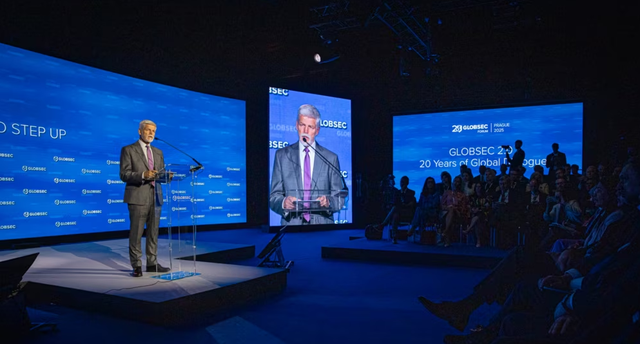
The GLOBSEC 2025 Forum – one of the main platforms for discussing global security and political challenges – opened in Prague on June 12. The Western Balkans is part of the agenda, but Kosovo is not represented at this event.
Representatives from almost seventy countries gathered in the capital of the Czech Republic on Thursday to participate in the 20th edition of the GLOBSEC Forum.
For three days, leaders will discuss the most pressing geopolitical, security, and geoeconomic challenges.
“We began in 2005 with hope, we continue in 2025 with responsibility. Let these three days be more than a dialogue, let them be a turning point. Let us take responsibility, let us lead, and let us build a future that others want to follow,” said GLOBSEC President Robert Vass at the opening of the Forum.
The forum, officially titled "Command in Chaos: It's Time for Europe to Take Responsibility," was opened by Czech President Petr Pavel, under whose patronage the event itself is taking place.
In his speech, he focused on the future of Ukraine, the new transatlantic environment, and European security.
Pavel emphasized that the role of the United States in European security is changing, therefore Europe must take more responsibility.
"We must accelerate our efforts to build credible European defense capabilities and strengthen our defense industries. This does not mean that we want to break away from our American ally. On the contrary, engaging and maintaining dialogue with our partners across the Atlantic is more important than ever," the Czech president said.
At the opening of the Forum, Ukrainian President Volodymyr Zelensky also spoke virtually, seeking support for increasing sanctions against Russia.
"Russia is not worried about a million victims, but about sanctions, including measures to reduce oil revenues," Zelensky said.
In addition to Ukraine, topics to be discussed at GLOBSEC 2025 will also include the precarious ceasefire in the Middle East, tensions in the Indo-Pacific, and the new climate following the US presidential election.
Donald Trump's return to the White House has reinvigorated debates over the sustainability of transatlantic ties and America's commitment to European security.
Meanwhile, the European Union is also facing internal challenges and political transitions that could affect its defense and enlargement agenda.
Speaking at a session at GLOBSEC, the Prime Minister of Croatia, Andrej Plenkovic – whose country is the latest to join the EU in 2013 – said that the Western Balkan countries still have a lot of work to do to join the European family.
He singled out Montenegro as the most advanced on this journey and said that Albania is also doing good work.
"For us, the main principle should be individual merit. We should reward those who meet the conditions, make reforms and successful negotiations. We should not leave them waiting for others who do not take such steps," Plenkovic said.
Of the six Western Balkan countries – Kosovo, Albania, Serbia, Montenegro, North Macedonia and Bosnia and Herzegovina – only Kosovo is not a candidate country for EU membership.
In this context, one of the special discussions at the GLOBSEC forum will focus on the Western Balkans region, through the panel "Western Balkans at a geopolitical crossroads: EU integration or rising regional tensions?".
For Kosovo, participation in such forums has been an opportunity to articulate state positions and emphasize the importance of Euro-Atlantic integration. But this year, its leaders are not participating.
President Vjosa Osmani, who was present at last year's forum, is on an official visit to Japan.
In addition to the political sessions, GLOBSEC will also organize this year the second edition of the Prague GeoTech Summit, which will explore the interactions between advanced technology, national security, and international relations.
The focus is expected to be on topics such as artificial intelligence, cybersecurity, next-generation technologies, and the global race for technological dominance.
For 20 years, GLOBSEC has hosted renowned international figures, such as Ukrainian President Volodymyr Zelensky, European Commission President Ursula von der Leyen, former NATO Secretary General Jens Stoltenberg, the late Pope Francis, and other leaders who have contributed to shaping the international debate. /REL
-

28-year-old found dead in Fier, suspected of hanging
June 12, 14:54 -
The still unpublished EP report, which knocks everyone down
June 12, 2:47 PM
Happening now...


America may withdraw from Europe, but not from SPAK
Nga Gentian Gaba
ideas

Who is the Surrel Rabbit?
Nga Sidi Hasanaj
The two wrong paths of the opposition with the Ombudsman
Nga Patrik Sadikaj
top


Alfa recipes




TRENDING 




services
- POLICE129
- STREET POLICE126
- AMBULANCE112
- FIREFIGHTER128